c. Domenick D'Andrea

The Battle of Brooklyn in Prospect Park

August 13, 2018

Long before designers Olmsted and Vaux reshaped the topography to create Prospect Park, the hills of Brooklyn served as the stage of the largest battle of the Revolutionary War in terms of total combatants: the August 27, 1776, Battle of Brooklyn. The chain of lowland hills that run through Brooklyn overlook long, open flatlands. In the 1770s, the area was covered with thick forest and brush. There were only four passes that cut through the rocky ridge, including Flatbush Pass in what is now Prospect Park.

Six weeks prior to this historic engagement, the Continental Army had captured Boston at the Battle of Bunker Hill. The Colonists knew that the British would respond by securing the most strategic military outpost, the port city of New York. General George Washington had already started moving troops to Brooklyn in early May, and General John Sullivan was charged to hold the ridgeline that extends from today’s Green-Wood Cemetery, through Prospect Park to Mount Prospect Park. Flatbush Pass, which runs between a cluster of rugged hills where today joggers strain up the park’s East Drive, was marked with a large white tree called the Dongan Oak, which was chopped down to impede the British advance.

On August 27, the Hessians (German mercenaries hired by the British) pushed up Flatbush Pass to meet the American blockade. The invading forces were instructed to wait to attack the Colonists until the British gave the signal. General Sullivan expected the British to travel from the Gowanus Pass, and was unaware that the British troops had found their way to Jamaica Pass, thanks to local Loyalists. At approximately 9 am, the British General James Grant fired a cannon to signal the Hessians to commence their attack. With the Hessians at the front and the British forces coming from the rear–over grounds now known as the Vale of Cashmere and Nellie’s Lawn–the American soldiers were completely caught by surprise, and fled in panic across today’s Long Meadow.

General Sullivan was unable to organize a retreat before the Hessians overtook the forward guard, and the fighting devolved into hand-to-hand combat. Some Americans escaped through the swampy landscape, some were captured and sent to British prison ships in Wallabout Bay, and others were battlefield casualties. Ninety years later, when the park was being built, remains of those soldiers were uncovered, as were American fortifications and gun pits.

The Battle of Brooklyn was the first conflict in the American Revolution after the July 4 signing of the Declaration of Independence, and these hills remained hallowed ground for the people of Brooklyn for many generations. The memory of Battle Pass was part of the reason the site was chosen for Prospect Park in the 1850s, and markers were added in the park to commemorate that fateful day in American history. Visitors can find three bronze plaques along the East Drive which describe the events and mark the line of defense as well as the location of the Dongan Oak. At the base of Lookout Hill, the Maryland Monument commemorates the heroic stand of Major Mordecai Gist’s Maryland Regiment, which numbered just four hundred men but managed to hold off two thousand Hessian and Scottish invaders around a Dutch farmhouse, now known to Brooklynites as the Old Stone House. Only ten men survived, and the monument is inscribed with General Washington’s exclamation, “Good God! What brave fellows I must this day lose.”

Celebrate Brooklyn’s Diverse Cultures at the Brooklyn Roots Festival

July 13, 2018

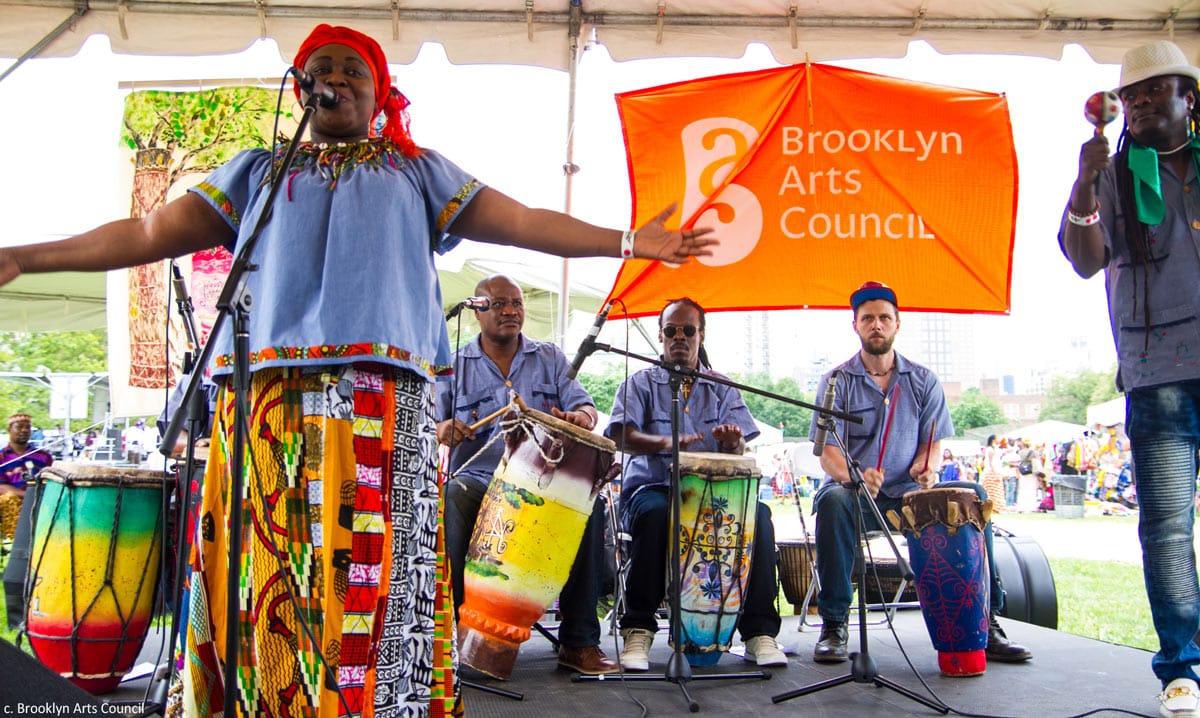
Pictured above, Afro-Puerto Rican drum and dance ensemble Bomba Yo. C. Brooklyn Arts Council.

On July 29, the Brooklyn Arts Council (BAC) and Prospect Park Alliance present the Brooklyn Roots Festival. This folk arts festival celebrates Brooklyn’s traditional artists and immigrant communities through performances, workshops, family activities and more.

This event is free, RSVP today to let us know you are coming!

RSVP-btn-orange.png

The festival is part of BAC’s summer-long Tradition as Resistance Festival. “Folk and traditional expressions are not relics,” said BAC Folk Arts Director Christopher Mulé. “These communities have much to teach us about moving forward in our current climate of social justice and protest. The Brooklyn Roots Festival provides a platform for multiple generations to celebrate traditions of resistance with pride.”

“Prospect Park is Brooklyn’s Backyard, and a haven for the diverse communities of this borough,” said Prospect Park Alliance Vice President of Programs Maria Carrasco. “The Alliance is dedicated to providing free public programs that celebrate the history and traditions of Brooklyn, and we are thrilled to partner on this first Brooklyn Roots Festival.”

The festival’s Main Stage will feature Palestinian dance ensemble Freedom Dabkah, Haitian drumming group Fanmi Asòtò, Afro-Puerto Rican drum and dance ensemble Bomba Yo, and other groups representing Yiddish, Serbian and African Diaspora cultures.

fanmi_asoto_bac.jpg

Pictured, Haitian drumming group Fanmi Asòtò. C. Brooklyn Arts Council.

In addition to the performance Main Stage, a workshop station will engage audiences with activities led by groups including the Queer Kitchen Brigade, the food-agro project working in solidarity with Puerto Rico’s sustainable agroecology movement; Gran Bwa and the Congo Square Drummers, sharing their longtime tradition of sharing tradition and ritual in the Prospect Park Drummer’s Grove; and dance and music workshops.

A children’s section at the Lefferts Historic House presents acclaimed “King of the Dance Party” Father Goose Music with a journey through Caribbean and multicultural music, East Asian folk children’s group Rabbit Days and Dumplings featuring Elena Moon Park, and puppetry presentations by the Czechoslovak-American Marionette Theatre. City Lore is also partnering with BAC to present the multimedia theater piece What We Bring: Stories of Migration.

This event is free, RSVP to let us know you are coming!

Pictured at top, Afro-Puerto Rican drum and dance ensemble Bomba Yo. In story, Haitian drumming group Fanmi Asòtò. C. Brooklyn Arts Council. 

Sanden Wolff

The New York Times Publishes Guide to Prospect Park

The New York Times recently published a guide, “How to Enjoy Brooklyn’s Prospect Park,” and we couldn’t agree more with the selection! The guide covers the 55-acre Lake, the rolling hills of the Long Meadow, and many other landmarks in between. The guide notes, “Prospect Park, which opened in 1867, is remarkable in its own right. The park is accessible year-round, but truly shines in the summer.”

Check out the The New York Times guide, and for more ways to enjoy the park, take a look at our Summer Fun Checklist: Kids Edition.

c. Martin Seck

City Funds Park Improvements

July 2, 2018

News Body Text

Amanda Gentile

PPA Profile: Mark Anthony’s 25 Years at the Alliance

June 20, 2018

This June, Prospect Park Alliance marks a staff milestone as Mark Anthony, the supervisor of our Natural Resources Crew, celebrates 25 years with the Alliance, the non-profit that cares for the park. When Mark joined in the early 1990s, the Alliance was only seven years old, just beginning to make its mark in the revival of these vast 585 acres. We sat down with Mark to catch up on the changes he has seen in the park and his reflections on 25 years.

Congratulations on 25 years at Prospect Park Alliance! How did you begin your work with the Alliance?

I grew up in Brooklyn, and came to the Alliance through a program called the City Volunteer Corps, an organization that took inner-city kids and placed them in jobs that helped clean up the city. I started in a horticultural position, and after six months and an exchange program in Washington, D.C., I took a seasonal horticultural position at the Alliance. I started learning the trade from there, pruning and taking care of trees. I also got a second seasonal position working at the old ice skating rink in the winters. I switched back to horticulture in the summer, doing woodland work, and going back and forth, until the Alliance hired me full-time to work in the woodlands.

What were the woodlands like in 1994?

It was decrepit and a mess; it was unsafe to go through. You didn’t even know the woods were there because there was a vast amount of erosion, graffiti and garbage: you couldn’t figure out what was what. The trees there were mostly invasive species, there were no native trees where wildlife could thrive. That was the main reason we created the Natural Resources Crew, to bring back the habitat, diversify the woodlands, and make it better so people could use the park.

Have you seen the results of your work in the park?

Our work in the woodlands—the Ravine, Midwood, and Lookout Hill—helped mark the boundaries, to show “here are the woodlands, here is a path”. We restored the habitat, rebuilt slopes, planted native species. We restored the waterfall in the Ravine. It was underground, so we had to dig it up and get the water flowing through it again.
Our work has been successful. Certain bird species come through the park that we hadn’t seen in years. Chipmunks are back in the park, I don’t know where they went but they’re back now, the population is growing. We have owls and Red-tailed hawks, egrets that nest here and continue to come back each year. And the people are enjoying the park, too. They’re enjoying them too much, but you can’t fault them for that. That’s the reason we do the work, it’s people’s habitat too.

What do you enjoy about this work?

My job is a different than it used to be when I first joined the Alliance. I’m supervising the work of a crew, but I still get a chance to get my hands dirty. I go out and push the mower, push the weed-whacker, and even that is gratifying. You transform the area, make it visible and safe, and now people can actually use it. There’s gratification in seeing your labor and hard work put into this place. Seeing trees I planted that are surviving, some 15-feet tall. Seeing landscapes I worked on a long time ago, and they’re still thriving. This is something that is part of what I need to be doing: giving back to nature, people and the world.


c. Paul Martinka

Name the Weed Harvester

June 1, 2018

Update, August 2018: The weed harvester has been named! With over 700 votes tallied, the winner by a margin of 30 votes is, “The Floating Goat.” Learn more about the public naming contest.

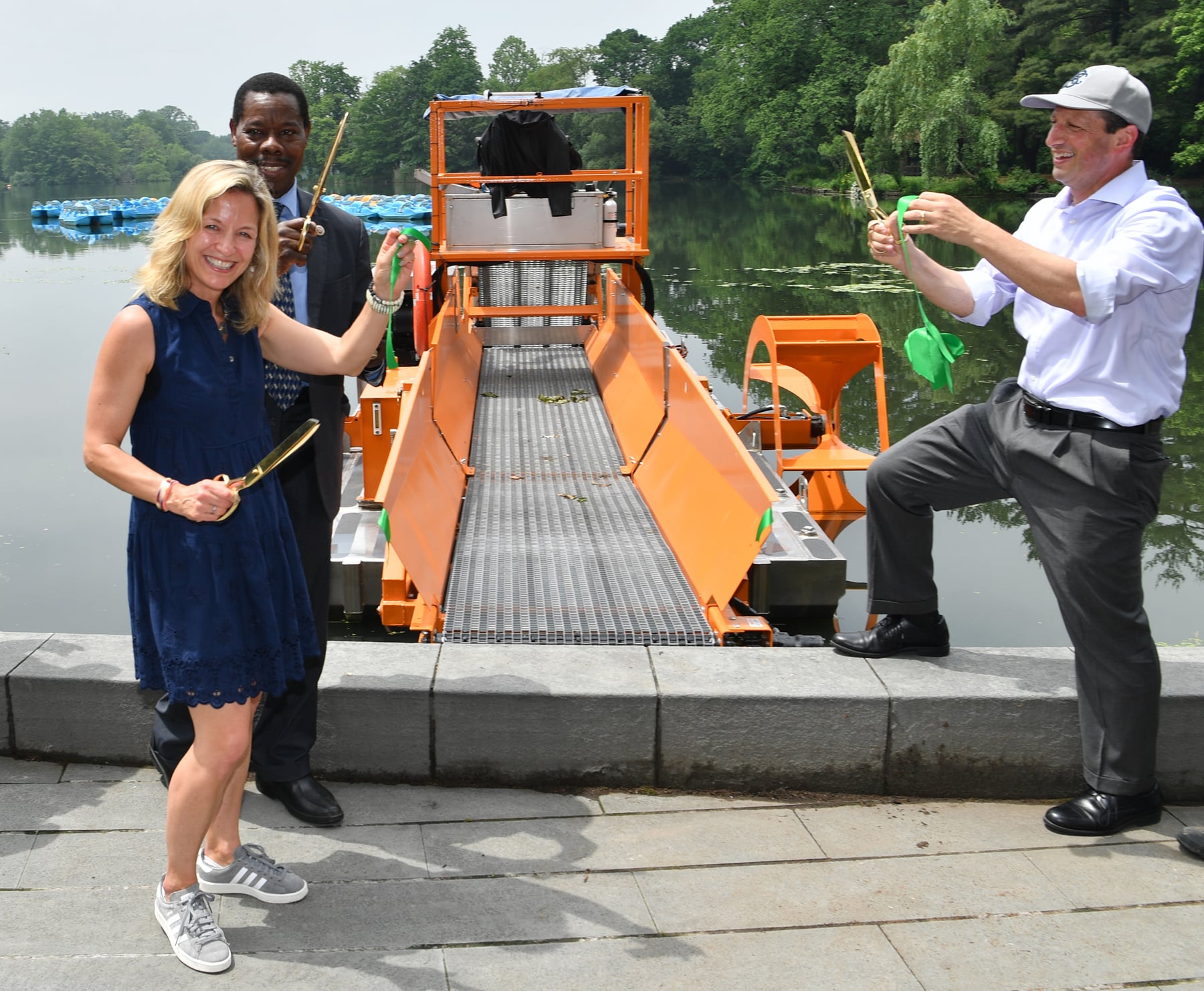
Prospect Park Alliance President Sue Donoghue and City Council Members Brad Lander and Mathieu Eugene celebrated the launch of the newest addition to the Prospect Park Alliance fleet—a brand-new aquatic weed harvester. This vehicle offers an environmentally sound method for Prospect Park Alliance’s Natural Resources Crew, a dedicated crew that cares for the park’s natural areas, to control excessive aquatic weed growth, such as floating water primrose and duckweed, which will help address the water quality of the 55-acre Prospect Park Lake.

City Council Members Brad Lander and Mathieu Eugene funded this $140,000 machine through the Participatory Budgeting Process; and were on hand to launch the vehicle and join Prospect Park Alliance President Sue Donoghue and members of the Alliance’s Natural Resources Crew on the inaugural trip around the Lake. This project is part of a broader focus by Prospect Park Alliance, the non-profit organization that sustains the park, to care for the Park’s natural areas.

Weed Harvester Ribbon Cutting

“Prospect Park Alliance’s Natural Resources Crew works tirelessly to maintain the health of the Park’s natural areas, including this 55-acre body of water—Brooklyn’s only Lake,” said Prospect Park Alliance President Sue Donoghue. “Thanks to Council Members Brad Lander and Mathieu Eugene, and everyone who took part in the Participatory Budgeting process, today we get to cut the ribbon on this exciting new piece of machinery that will provide an environmentally sound method for the Alliance to control weeds and improve the water quality of the Prospect Park Lake.”

“The new aquatic weed harvester is one of many exciting improvements in Prospect Park that will help keep one of Brooklyn’s most heavily used resources in great shape, especially during the busy spring and summer seasons,” said NYC Parks Commissioner Mitchell J. Silver, FAICP. “We greatly appreciate the investments from our local elected officials that allow us to better care for one of the borough’s most beloved public spaces.”

“I’m thrilled to take part in the unveiling of the newest tool to reduce invasive weeds and keep Prospect Park Lake healthy– this Aquatic Weed Harvester” said Council Member Brad Lander. “It’s always exciting to see a Participatory Budgeting project idea become a reality, and I want to extend my deep thanks to Prospect Park Alliance for their work in making this happen. I also want to thank our district’s 2016 Participatory Budgeting Parks Committee, as well as delegates August Wendell, Josh Torpey, and his son Nicholas, who at the time was the youngest PB delegate! Without their work, this project would not have been possible.”

“As a longtime advocate for Prospect Park, I am honored to partner with Council Member Brad Lander, the Prospect Park Alliance, and the Participatory Budgeting Project to allocate $140,000 in funding for a new Aquatic Weed Harvester,” said Council Member Mathieu Eugene. This state-of-the-art machine is designed to significantly improve the water quality of Prospect Park Lake, which will in turn provide a long term benefit the park’s ecosystem. I also want to commend our constituents who made this initiative possible through the Participatory Budgeting Process. Today’s event is a reflection of our shared commitment as a community to protecting green spaces for future generations of New Yorkers.”

A photo op will be scheduled in the coming weeks when the “Floating Goat” is decaled.

Prospect Park Alliance

Pavilion Wins Design Award

May 24, 2018

Prospect Park Alliance was honored with a 2018 Award for Excellence in Design by the New York City Public Design Commission for the design of the proposed restoration of the Concert Grove Pavilion. 

Through $2 million in funding by former Speaker Melissa Mark-Viverito and the Brooklyn Delegation of the New York City Council, the Alliance will restore this historic structure, which was closed to the public in 2014 due to structural damage, and return this treasured community resource to public use. Surrounding pathways, lighting and landscaping will also be restored. The project is estimated completion by Fall 2019.

Designed by Calvert Vaux in 1874, the Concert Grove Pavilion features eight cast-iron columns supporting a decorative metal-and-wood roof with a stained-glass skylight. Typical of the day, the design borrows motifs from Hindu, Chinese, Moorish and Egyptian architecture. Situated in the Upper Concert Grove in the Park’s southeast corner, adjacent to Lakeside, the pavilion was almost completely destroyed by fire in 1974, but the elaborate cast iron columns were salvaged and the pavilion was restored in 1987. 

The current project was designed in-house by Prospect Park Alliance’s Capital Projects team, which includes architects, landscape architects, construction supervisors and an archivist. The restoration will repair water damage, reconstruct missing historical details, and repaint the structure based on historic images, bringing new life to this charming and historic community gathering place.


New Vision for the Rose Garden

May 23, 2018

Prospect Park Alliance, the non-profit organization that sustains, restores and advances Prospect Park, Brooklyn’s Backyard, has announced the results of a year-long effort to develop a community-driven vision for the park’s former Rose Garden.

This initiative is part of a larger effort by Prospect Park Alliance to restore the northeast section of the park, which also includes the restoration of the Flatbush Avenue park perimeter, a major restoration of the woodlands, as well as path and lighting improvements to make this area of the park more inviting and accessible to the public.

“Prospect Park is one of the increasingly rare, truly democratic spaces where a wide variety of people of different nationalities, cultures, ethnicities, races and socio-economic backgrounds intermingle,” said Sue Donoghue, Prospect Park Alliance President. “To make a more vibrant place for all of Brooklyn, we reached out to the many communities that use and border the park—particularly communities of color, young people, low-income families and new immigrants. Reaching out in multiple languages, in varied formats and at local venues ensured that people whose voices are often missing from local decision-making helped shape the future of this space.”

Prospect Park Alliance teamed up with Hester Street, a non-profit organization that works to ensure neighborhoods are shaped by the people who live in them, and Grain Collective, a landscape architecture and urban design practice, to engage local communities in the future vision of this little-known landscape. The Alliance engaged over 2,000 community members and local stakeholders over the course of this outreach effort, and gathered over 3,000 ideas. Ideas for the reimagined Rose Garden were gathered through a series of interviews, focus groups, “pop-up” events, in-person and online surveys, and workshops. This work was made possible through the support of the Altman Foundation.

The resulting, community-driven vision was informed by a set of guiding principles developed by community members and the Alliance to ensure any future improvements are in line with community priorities, as well as site and feasibility factors. Top priorities expressed were preserving the bucolic character of the space, and creating a welcoming environment to a broad array of communities.

“The many people we talked to were clear: the area must be open, accessible and inclusive of the diverse communities that border the Rose Garden and use the space,” reported Betsy MacLean, Executive Director of Hester Street, “and that community engagement and participation in the future design and programming of the park must be ongoing.”

View the findings of this year-long community engagement effort.

In the coming years, the Alliance will oversee related improvements to park’s northeast corner, including: the Flatbush Avenue perimeter restoration; path and lighting improvements; and the creation of two new entrances to the park. In the meantime, Prospect Park Alliance will further develop and refine design concepts for the former Rose Garden; determine the scope and budget for the project; and develop a broader fundraising campaign for the park to make this project a reality.

Learn more at prospectpark.org/reimagine.

c. Brklyn View Photography

New Prospect Park Caterers

Prospect Park Alliance, the non-profit organization that sustains Prospect Park, has announced a new roster of caterers for weddings and special events at the Prospect Park Boathouse and Picnic House. 

Built in 1905, the Boathouse in Prospect Park is a Beaux Arts building with beautiful floor-to-ceiling windows, a Guastavino tile ceiling, a hand-painted mural, a covered balcony and large terrace overlooking the scenic Lullwater and Lullwater Bridge. It was one of the first buildings in New York City to be declared an historic landmark. Due to its landmark status, Prospect Park Alliance has selected an exclusive caterer for this venue: Purslane, by the team behind well-loved Brooklyn restaurants Rucola, June and Metta. The Boathouse is available spring through fall for daytime and evening rentals, and can accommodate up to 150 guests for a seated dinner and dancing.

The Prospect Park Picnic House, built in 1927, is a 4,000-square-foot, Renaissance-Revival building with a terracotta tile roof, floor-to-ceiling windows, and French doors that lead to a small terrace. The Picnic House is situated on a knoll overlooking the picturesque 90-acre Long Meadow, and boasts sweeping views and light-filled interiors, as well as charming details such as a wood-burning fireplace that make it an ideal venue year round. The space can accommodate up to 175 guests for dinner and up to 240 for cocktail parties. The Alliance offers several catering options at the Picnic House, including Bension Kohen Caterers (Glatt Kosher), Bon Soir Caterers, Food Trends Catering & Events, Purslane and Simply Divine (Glatt Kosher).

Learn more about weddings in Prospect Park.

About Bension Kohen
Since 1979, the family-owned Bension Kohen Caterers has served the Brooklyn community with dedication and warmth. We strive to ensure that your event is beautiful, efficient and elegant.

About Bon Soir Caterers
Bon Soir Caterers is proud to have served clients both private and corporate for the past 20 years at the Picnic House. We are a full-service off-premises catering firm offering a wide range of custom menus and services to fit our clients’ needs and budgets.

About Food Trends Catering & Events
With over 25 years experience, Food Trends is renown as a premier NYC catering and events company that is proudly woman-owned and family-run. Our success is attributable to sourcing the freshest ingredients from local vendors, trend-setting design, and personal “family-style” service to ensure your event is nothing short of spectacular.

About Purslane
Purslane brings decades of experience to executing weddings of all sizes and styles. Its food is ingredient-driven with a slow-food ethos and a vegetable-focused menu. Purslane believes in delicious, sustainable and beautifully executed food; sourcing its ingredients locally and humanely, and reducing food waste with an eye toward a zero-waste policy. Executive Chef Partner Arden Lewis is an alumnus of both the Culinary Institute of America and The French Culinary Institute, and has worked with notable chefs such as Brad Farmerie at Public, Cesar Ramirez at Bar Blanc and Nick Anderer at Maialino. 

About Simply Divine
Simply Divine (Glatt Kosher) is NYC’s premier boutique event planning, design, and kosher catering company. Seamlessly blending exquisite cuisine, superb service, and innovative décor, we listen to you and make your day unforgettable.

Prospect Park Alliance is the non-profit organization that sustains, restores and advances Prospect Park, Brooklyn’s Backyard, for the diverse communities that call Brooklyn home. The Alliance provides critical staff and resources that keep Prospect Park green and vibrant. 

Upsilon Ventures

Summer Fun Checklist: Kids Edition

May 14, 2018

Warm weather has arrived, and with so many fun activities for kids and families to enjoy in Prospect Park, you can spend all summer enjoying Brooklyn’s Backyard. Here is our checklist for must-do activities this summer:

  1. Visit the LeFrak Center at Lakeside: You’ll need to plan more than one visit to enjoy all the fun activities that Lakeside has to offer. Try roller skating, biking and boating for all ages, or it it’s too hot, run around in the jets on the Splash Pad, the park’s largest water play area, opening Memorial Day weekend.  
  2. Explore Nature with Pop-Up Audubon: From May through September, enjoy nature programs while exploring the Park with the Alliance’s Pop-Up Audubon program, made possible through the generous support of ConEdison and the Brooke Astor Fund for New York City, which takes place in different natural areas throughout the Park. Featured topics this summer include Radical Raptors, Climate Clues, Incredible Invertebrates and the Macy’s Fishing Clinic.
  3. Attend a Concert: The BRIC Celebrate Brooklyn! Festival is back in Prospect Park. In 2018, the festival celebrates its 40th season with 31 performances, running from June 5–August 11, including a free family concert featuring Los Lobos on June 10.
  4. Visit All the Playgrounds: Believe it or not, Prospect Park is home to seven playgrounds! Located throughout the Park, they offer children engaging opportunities for safe and imaginative play. Don’t miss the Zucker Natural Exploration Area, named the Best of New York by New York Magazine.
  5. Ride the Carousel: Located in the Park’s Children’s Corner, the Carousel is one of the Park’s most popular attractions for visitors of all ages. Its 53 magnificent horses ride alongside a lion, a giraffe, a deer and two dragon-pulled chariots. And you can book a birthday party at the Carousel to boot!
  6. See a Summer Movie: Pack a picnic and head to Prospect Park, because summer movies are returning to Prospect Park’s Long Meadow for four Wednesdays in July and August! A Summer Movie Under the Stars series, presented by Brooklyn Borough President Eric L. Adams and Prospect Park Alliance in partnership with Brooklyn’s Nitehawk Cinema, brings free family-friendly movies to Brooklyn’s Backyard. Enjoy screenings of Alice and Wonderland, Space Jam and more.
  7. Travel Back in Time: See how Brooklynites lived way back when! Built by a Dutch family in the 18th-century, the Lefferts Historic House features a working garden, historic artifacts, period rooms and exhibits. Kids can play with traditional tools, toys and games and engage in historic activities.
  8. Bite into a Breakfast Taco: Everybody loves a taco, and you can pick up an authentic, Austin-style breakfast taco seven days a week at King David Tacos, located at Grand Army Plaza.