Ladybugs to the Rescue

November 13, 2018

First goats, now… ladybugs? Prospect Park Alliance is always on the lookout for innovative and environmentally friendly ways to sustain the park. In recent years, this meant a crew of goats to clear invasive weeds, and this past summer it meant the introduction of tens of thousands of ladybugs to combat a new challenge: lace bugs.

“We noticed that the asters were dying,” said Allie Loux, Prospect Park Alliance Assistant Gardener at the LeFrak Center at Lakeside. “They were turning yellow and brown and covered in these little dots.” Asters are an important perennial species and one of the most common flowers in Prospect Park, often sporting purple or white flowers. Lakeside’s aster plants had been hit with a lace bug infestation. These miniscule insects feed on the leaves of flowering plants and shrubs, and in high concentrations they can spell disaster for plants.

Alliance gardeners needed to find a solution to their lace bug problem, and wanted an alternative to traditional pesticides. “Lakeside is very wild,” said LJ Philp, Alliance Lead Gardener at Lakeside, “and when you’re spraying chemicals, you’re going to hit something else.”
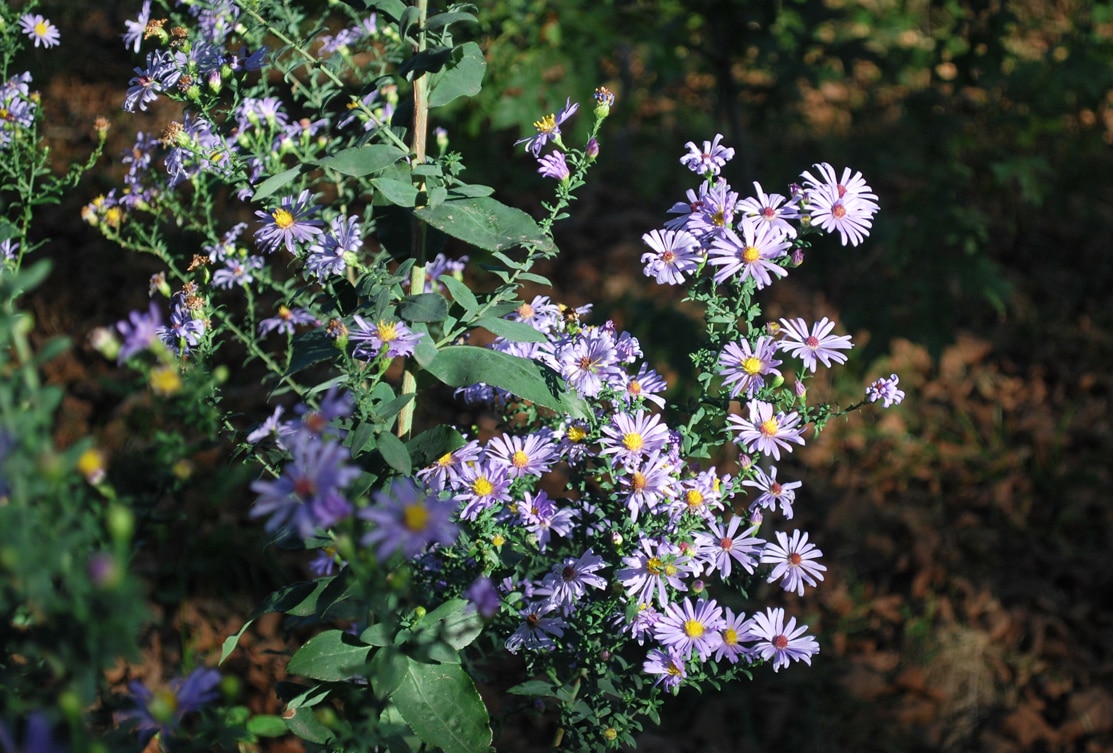
aster.jpg

Aster plants in Prospect Park, photo courtesy of Christian Zimmerman, Prospect Park Alliance Vice President of Capital and Landscape Management 

While Prospect Park’s 585 acres may seem wild, this green space is a carefully cultivated ecosystem, and the Alliance’s crews avoid introducing chemicals whenever possible. Loux added, “when we use toxic chemicals, it’s getting in the air, in the water, harming our bodies as well as the animals and the plants. Maybe a pesticide will get rid of the lace bugs, but it will also probably kill something else.”

Their first course of action was to test neem oil, a natural pesticide derived from the neem tree. When they realized the necessary quantity of the oil would be prohibitively expensive and application would be time consuming, the gardeners got creative.

“Integrative pest management practices (the broad-based approach that integrates practices for control of pests) suggested finding a natural predator,” said Philp, “and ladybugs seemed like a great fit.” Introducing ladybugs, an insect not found in great quantities in the park, could be a tactic for managing the lace bug infestation while avoiding harmful chemicals, and sparing staff hours. “We did our research and weren’t worried that the ladybugs would out-compete other species or take over, so we decided to give it a try.”

In July, the gardeners, including Uriel Walker (formerly an Assistant Gardener at Lakeside) received their shipment of ladybugs, 72,000 for a grand sum of $150, and dispersed them in locations around Lakeside. They even left them with damp cardboard boxes smeared with honey (food and lodgings). “We wanted them to feel like they were in a safe place,” said Philp.

So, was this experimental treatment a success? “The lace bugs went away,” said Philp, “it worked!” In just a few short weeks, the infestation had cleared and the asters revived. In finding a creative solution, these Alliance gardeners preserved one of the park’s natural habitats, and added a few thousand lucky bugs to the ecosystem in the process.

Learn more about how Prospect Park Alliance sustains the park environment.
c. Harpers

Prospect Park’s Bizarre Bygone Attraction

October 17, 2018

Prospect Park has seen many attractions come and go over its more than 150 year history. One of the more unusual—at least by today’s standards—is the Rotary Yacht.

In the summer of 1878, Park Commissioners gave the green light to inventor David Smith to operate a 225-foot circular water ride called the Rotary Yacht in the Upper Pool (today, nearby to the popular Dog Beach). Hailed by The Brooklyn Eagle as an “ingenious and useful contrivance,” and a “queer looking craft,” the Rotary Yacht was a spectacular sight. Floating in the water just off the Long Meadow, the boat was lit with colorful lanterns and adorned with the “flags of all nations.”

The yacht was powered by nine sails, which could hold up to 220 riders for a spin around the yacht’s center post every 90 seconds. The newspaper described the summer of 1878 to be particularly hot, and there was “not a breath of air stirring.” Most of Brooklyn had gone to Coney Island to escape the heat, leaving Prospect Park rather desolate. For the people who lived nearby, the Rotary Yacht was a fantastic amusement.

While the yacht was a pleasant attraction for most, stories have been told of some falling  into the water and one death was associated with the structure. The yacht was removed in 1883, but the bygone boat now lives on in archives.

Learn more about the park’s past in the Prospect Park Archives.

c. Martin Seck

Fall Things to Do in Prospect Park

Prospect Park’s most colorful season has arrived, and  Prospect Park Alliance has plenty of ideas of how visitors of all ages can enjoy this time of year in Brooklyn’s Backyard. Here is our checklist for autumnal fun in Prospect Park, get out and experience it all!

  1. Take a fall foliage walk! Check out some of our favorite routes through the park to see  the stunning colors of autumn, from the Peninsula to Lookout Hill, the Nethermead, the Lullwater and beyond.
  2. Bid adieu to the birds. Fall is migration season in Prospect Park, with hundreds of species of birds stopping through these 585 acres on their way to their winter homes. Read our tips for birdwatching in Prospect Park, and check out upcoming bird walks you can join!
  3. Strap on your skates because starting October 26, the LeFrak Center at Lakeside is open for ice skating, hockey, broomball and curling. Enjoy these wintertime activities surrounded by the picturesque autumn colors, and before the arctic weather sets in!
  4. Learn more about nature at the Prospect Park Audubon Center. Prospect Park Alliance presented free nature activities Thursday through Sunday in October, and Saturday and Sunday in November and December. Take a birdwatching walk, introduce your  child to the creatures that creep, crawl and fly in the park. Plus, pick up ready-to-go Discovery Packs filled with nature activities for families!
  5. Go for a run. Ready to break a sweat? Fall is the perfect time to go for a run in Prospect Park and admire the colorful foliage from the park’s 3.36-mile loop, not to mention the paths that run through the natural areas of the park. Prefer an indoor activity? The indoor tennis season kicks off October 22 at the Prospect Park Tennis Center. Sign up for a seasonal court or lessons today.

Prospect Park Carousel is a Treasure of New York

September 18, 2018

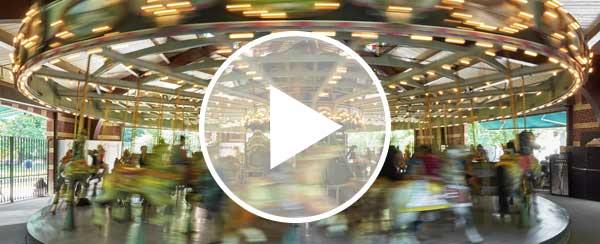
Prospect Park’s historic Carousel was recently a feature of THIRTEEN’s Treasures of New York, highlighted as an “Historic Gem in Brooklyn.” The segment tells the history of carousels in Prospect Park, including the current carousel, which was built in 1912 by one of the foremost carousel designers of the day, Charles Carmel. It came to the park in 1952, but fell into disrepair in the 1970s. In 1990, the newly formed Prospect Park Alliance—the non-profit that sustains, restores and advances the park—undertook the restoration of the Carousel in an effort to return this landmark to its original glory. The project was a great success, and today the Carousel and its 53 hand-carved horses (plus assorted dragons, giraffe and deer) is just one of the many attractions that draws millions of visitors to the park each year.

Watch the video feature: 

carousel_video.jpg

Today, the Carousel is one of Prospect Park’s most popular venue for children’s birthday parties! Learn more about having your next party at this beloved landmark. 

c. Elizabeth Keegin Colley

The Results Are In! Prospect Park Tree Survey

September 14, 2018

Prospect Park is an arboreal wonderland! Through a $75,000 Urban Forestry Grant from the New York State Department of Environmental Conservation, Prospect Park Alliance recently surveyed roughly 12,000 of the park’s 30,000 trees as part of its work in caring for the Park’s natural areas.

The survey not only provides a more nuanced picture of the park’s evolving ecosystem, but important insights into the economic, environmental and health benefits of Brooklyn’s Backyard. Conducted by Davey Resource Group (DRG), a well-respected urban forestry consultancy that has worked extensively in New York City, you can examine the results on the Prospect Park TreeKeeper Interactive Map.

“The survey has provided exciting insight into what we already knew were some of the park’s most important treasures, its trees,” said Prospect Park Alliance President Sue Donoghue. “We are all aware of how special this urban green space is, but now with this data we can quantify the economic benefit our community receives from these trees. It clearly reinforces just how precious this resource is, and how we must all do our part to care for it.”

During the survey, arborists inventoried trees primarily in the landscaped areas of the park, a total of 12,414 trees. Among the findings:

  • The surveyed trees provide more than $1.5 million in annual environmental benefits. This includes:

    • Air quality: 24,000 pounds of pollutants removed from the air each year, valued at $125,000;

    • Greenhouse gas benefits: 3,000 tons removed from the air, valued at $17,000;

    • Energy benefits: equivalent to 1,000 megawatt hours saved, valued at close to $700,000;

    • Storm water runoff benefits: 21 million gallons saved from the city sewer system, valued at $172,000.

  • There is a plethora of trees to be found in the park, including the 84 genera and 193 species represented in this survey. This includes numerous varieties of native cherries, maples and oaks, representing 41% of the trees surveyed, as well as less common species included the Southern magnolia, a fragrant, flowering tree whose northern range is growing due to climate change, and the bald cypress, which typically grows in swampy conditions and sends up knobby root growths called “knees.”

  • The largest tree surveyed has a diameter of 77 inches, or 6 feet, 5 inches across! This specimen tree, an American elm located near the Bandshell, is estimated to be over 100 years old.

  • The inventory also identified challenges faced by the park’s trees. The overall condition of the inventoried tree population is rated fair, however, 8% of the inventoried trees had stress caused by humans.

  • Emerald ash borer, an invasive beetle, was detected in the park’s ash tree population. And, though they have not been detected in Prospect Park, Gypsy moths and Asian Longhorn beetles pose the biggest threats to the health of the inventoried tree population.

  • A tree survey metric, “replacement value,” describes the historical investment in trees over time. The surveyed park trees have an estimated replacement value of more than $59 million!

In completing this report, DRG put together a Prospect Park Tree Management Plan, charting out the tree maintenance and planting needs in the park for the next five years. “By tracking the park’s trees, the Alliance can better care for these important natural resources, which play a big role in Brooklyn’s quality of life,” said John Jordan, Director of Landscape Management at Prospect Park Alliance.

There is a long way to go for Prospect Park Alliance to keep this vital community resource healthy and safe. Contributions from community members help sustain the park’s trees and fund the Alliance’s team of arborists and natural resources crew.

One way to support this important work is through the Alliance’s Commemorative Giving Tree Program. During planting seasons that take place each fall and spring, members of the community have the opportunity to plant a new tree in Prospect Park. Through this program, roughly 1,100 trees have been planted over the past 30 years. Each year, the Alliance plants a community tree on Arbor Day: learn more about how to get involved in this community celebration.

Want to learn more about Prospect Park’s trees? Check out the Prospect Park TreeKeeper Interactive Map to get info on each of the surveyed trees and their benefit to the community.

Take a Run in Prospect Park

September 12, 2018

Prospect Park is an amazing destination for runners and walkers, right in Brooklyn’s Backyard. 

Prospect Park features a 3.36-mile running lane along the Park Drive, which went car-free in 2018. The park’s 585 acres feature miles of trails and pathways that transverse hills, meadows and even picturesque waterways, maintained by Prospect Park Alliance, the non-profit organization that provides critical staff and resources that keep the park green and vibrant. This varied landscape is the perfect place to test your mettle and push yourself in your next run.

“Prospect Park is a great change from the crowded Central Park,” says Steve Mura, manager of runner training & education at New York Road Runners and also an NYRR Group Training coach in Prospect Park. “The 3.36-mile Park Drive loop offers a change of terrain as well as scenery,” says Mura, “and you can further change it up by cutting through Center Drive or Wells House Drive.”

Want to train on a trail less traveled? “There are some great trails in the park that will loop you around the inner area,” says Mura. “Get lost trying to find some historical area of the park, like Lookout Hill, the highest point in the park, with great views of Brooklyn—you might even be able to see Coney Island; Harry’s Wall, which honors Prospect Park Track Club co-founder Harry Murphy; and Cleft Ridge Span, a decorative concrete arch that dates back to 1872.”

Ready to push yourself? “That Battle Pass hill is a challenge! Run by effort,” advises Mura. “Your pace will slow down, but that effort level should stay the same. On the downhill, watch your effort. You want to stay controlled down the hill and stay in your rhythm.” 

Ready to get out in the park? Take a look at Prospect Park Alliance’s downloadable running map with mileage and distances in Prospect Park, then check out NYRR’s 3-mile Prospect Park running route, which passes 10 different points of interest in the park. For everything else, head to prospectpark.org/running.

Alliance Receives $8.9M for Restoration of Grand Army Plaza

August 24, 2018

Prospect Park Alliance is delighted to announce that our organization has received funding from the City to undertake a range of important capital projects in the park. This work, which will be undertaken by the Alliance’s award-winning design team, adds to a full slate of projects currently underway in the park. Review these on our Capital Projects Tracker.

Most significantly, today Mayor Bill de Blasio announced he is providing $8.9 million to restore Grand Army Plaza, more specifically the historic Soldier and Sailors Memorial Arch and the landscaped berms that frame the Plaza.

Grand Army Plaza is the formal entrance of Prospect Park. In 1889, the Plaza became the site of the Soldiers and Sailors Arch, which was dedicated in 1892 to commemorate those who fought with the Union troops during the Civil War. The Arch was landmarked in 1975, when the structure was in severe disrepair, and in 1976 the figure of Columbia literally fell from her chariot. The City undertook a restoration of the Arch in 1980.

Nearly 40 years later, the Arch is once again in need of restoration. This $8.9 million capital project will enable the Alliance to replace the Arch’s roof, clean and repoint the brick and stone structure, repair the interior iron staircases that lead to the roof, and replace the interior and exterior lighting. The project will also include replanting the landscaped berms that frame the Plaza on its east and west sides, which are sustained by Alliance horticultural crews and volunteers. This includes adding new trees and replacing the existing chain link fence with a low steel panel fence. Additionally, the Alliance will remove the broken bluestone pavement that surrounds the plaza’s John F. Kennedy Memorial and the Bailey Fountain with granite pavement.

In addition to the restoration of Grand Army Plaza, Prospect Park Alliance also received $1 million in funding from the Brooklyn delegation of the New York City Council for infrastructure improvements to the park’s former Rose Garden in the northeast corner of the Park. Together these projects advance the Alliance’s current focus on the northeast corner of the park, which also includes the restoration of the Flatbush Avenue perimeter of the park, through funding from Borough President Eric Adams and New York City Council Majority Leader Laurie Cumbo; the construction of two new entrances to the park on Flatbush Avenue—the first new entrances to the park since the 1940s—through funding from NYC Parks through its Parks without Borders program; and restoring pathways, benches and lighting in the northeast corner of the park through funding from the mayor.

This year the Alliance also received funding from City Council Members Brad Lander and Mathieu Eugene through the Participatory Budgeting process, where community members vote on funding projects at the heart of the community. Prospect Park Alliance has always done well in this process, which is a testament to how much the park means to each of you. This year, we received funding from Council Member Lander to create a senior fitness playground at Harmony Playground, as well as make general improvements to this cherished playspace, and Council Member Eugene provided funding for a second adult fitness area in the Parade Ground. These are a testament to the park’s importance in Brooklynites’ quality of life.

Please visit our Capital Projects Tracker to learn more about the full range of projects currently in the works in Prospect Park.

c. Ciro Photography

4 Seasons of Picnic House Weddings

August 15, 2018

The Picnic House is a charming and historic event venue in Prospect Park, adaptable for occasions in all four seasons. With scenic views of the 90-acre Long Meadow, outdoor access and a working wood fireplace, it provides a bucolic setting in the heart of Brooklyn. See a slideshow of Picnic House weddings in each season, and get  ready to plan your own!

Spring
There is no more romantic time or place to get married than Prospect Park as it bursts into bloom in the springtime. The Picnic House is surrounded by daffodils, forsythia and other early-blooming spring flowers. Decorate with budding branches and enjoy the outdoor access afforded by the venue.

Summer
In summer, take advantage of one of the Picnic House’s most popular features–the space to have an outdoor wedding ceremony overlooking the rolling lawn of the Park’s 90-acre Long Meadow. With this bucolic setting, your wedding will look like it is taking place in the countryside. Plus, during the warmer months, Prospect Park Picnic House caterers can grill outdoors. If you’re looking to have a barbecue or grill out wedding, take advantage of this option!

Autumn
In fall, the park bursts into a riot of colors–a gorgeous backdrop for your special day. The crisp weather means you can still take advantage of the outdoor space and head back indoors to party the night away.

Winter
In winter, enjoy panoramic views of the Long Meadow blanketed in snow from inside the cozy Picnic House. In these darker months, decorate with candles and don’t forget about the venue’s wood-burning fireplace!

See a slideshow of Picnic House weddings in all four seasons. 

Interested in having your wedding at the Picnic House? Fill out our contact form today.

Kate Abrams

The Weed Harvester’s New Name

August 14, 2018

When Prospect Park Alliance President Sue Donoghue and City Council Members Brad Lander and Mathieu Eugene celebrated the launch of a brand-new aquatic weed harvester, it kicked off a contest to name the new machine. Over the course of six weeks, over 300 entries were submitted, narrowed down, and voted on by the park community. With nine final options and over 700 votes tallied, the winner by a margin of 30 votes is, “The Floating Goat.”

The weed harvester offers an environmentally sound method for Prospect Park Alliance’s Natural Resources Crew–a dedicated crew that cares for the park’s natural areas–to control excessive aquatic weed growth, such as floating water primrose and duckweed. Keeping these weeds at bay helps address the water quality of the 55-acre Prospect Park Lake. City Council Members Brad Lander and Mathieu Eugene funded this $140,000 machine through the Participatory Budgeting Process; and were on hand to launch the vehicle in June 2018 and join Prospect Park Alliance President Sue Donoghue and members of the Alliance’s Natural Resources Crew on the inaugural trip around the Lake. This project is part of a broader focus by Prospect Park Alliance, the non-profit organization that sustains the park, to care for the Park’s natural areas.

An earlier aquatic weed harvester had been dubbed, “The Lake Mess Monster,” often shortened to “Messy.” The Alliance decided to open the naming of the new harvester to the public, and in the first stage of the public naming contest over 300 potential names were submitted, largely by local residents. Those entries were narrowed down by Alliance staff, and nine were chosen as the finalists to by voted on by the community. The options were as follows: Chompy, Da Pride O Lakeside, The Floating Goat, Harvey the Harvester, Lake Mess Monster II, The Little Orange Peel, Orange Crush, The Sea Slurpent, and Weedzilla. Voters were allowed one pick per email address and three weeks to vote.

When the voting ended, and more than 700 votes were tallied, the winner by a margin of 30 votes was, “The Floating Goat.” The winning entry was submitted by Jack Costas (8), a “lifelong Prospect Park adventurer and proud Alliance member.” The name was inspired by the Alliance’s resident goat herd, which was brought in by the Alliance in 2016 and 2017 as part of a Superstorm Sandy grant from New York State Parks to help clear invasive weeds in the park’s hard-hit woodlands. The aquatic weed harvester will accomplish a similar task in Brooklyn’s only lake, and the Alliance is thrilled to welcome yet another “Goat” to the herd. Costas will receive a Prospect Park Alliance “swag” bag and will participate in a photo-op when the vessel has been lettered.

Learn more about the “Floating Goat,” the new aquatic weed harvester.

The Alliance’s Growing Greenhouse

This year, the Prospect Park Alliance horticultural crew dug in and got their hands dirty in order to make an exciting new addition to their team: a greenhouse. The existing structure, located in the park’s Garage Compound space for maintenance and operations, had last been used for this purpose roughly 20 years ago, and had served as storage in recent years.

The resurrection of the greenhouse was primarily undertaken by LJ Philp (Lead Gardener at the Lefrak Center at Lakeside), Uriel Walker (Assistant Gardener, Lakeside) and Allie Loux (Assistant Gardener, Lakeside), with the intention of creating a facility for Alliance gardeners to learn, experiment and move Prospect Park towards greater self-sufficiency and resiliency. 

With 19 variations of native species of plants, including grasses (Virginia wild rye, Little bluestem and Purple love grass) and broadleaf flowering plants (Black-eyed susan and Beardtongue foxglove), the three gardeners, along with the support of other Alliance staff, have nurtured the greenhouse back to life.

The undertaking required carpentry work (including the creation of roll-up sides for ventilation, meshing for shade, and a sliding door to combat heavy winter snow), as well as the installation of a misting irrigation system. The seven-month-old greenhouse is bursting with life and ecological lessons. 

The trial of learning how to grow these specific native plants from seed has proved to be a hands-on process of “positive trial and error,” says Philp. By supplementing the plants purchased at a nursery with home-grown additions, Prospect Park Alliance gardeners can better understand the full lifespan of Prospect Park’s plants and move towards self-sufficiency.

These native plants will not only live longer and thrive with less care, but they will also serve as a greater addition to the park’s ecosystem: providing food and habitat for native wildlife and pollinators and enhancing the park’s resiliency to help it thrive for years to come. 

The project is still young, and the team has bright eyes for the possibilities it can bring to Brooklyn’s Backyard.

Learn more about the Alliance’s work to sustain the Park’s environment.