Brittany Buongiorno

Alliance Considers the Forest (and the Trees)

May 14, 2018

On a recent spring morning, Prospect Park Alliance kicked off a survey of trees in Prospect Park as part of its work in caring for the Park’s natural areas. This project is funded through a $75,000 Urban Forestry Grant from the New York State Department of Environmental Conservation (DEC). 

As part of its mission to sustain, restore and advance Prospect Park, Prospect Park Alliance has been working to revitalize the Park’s natural areas over the past two decades, a more than 20-year, $15 million investment that has encompassed the planting of more than 500,000 trees, plants and shrubs. Alliance staff include trained arborists, horticulturalists, a forest ecologist and a Natural Resources Crew. The results of this investment can be seen in the transformation of these once-derelict areas into some of the Park’s most scenic destinations.

Over the past two years, through $1.2 million in grants from the National Parks Service through the Hurricane Sandy Disaster Relief Assistance Grant Program for Historic Properties, administered by New York State Office of Parks, Recreation and Historic Preservation, the Alliance has been restoring the woodlands in two areas particularly devastated by Hurricane Sandy and other severe storms: the Vale of Cashmere in the northeast corner of the park, and Lookout Hill near the Nethermead and Peninsula (the Alliance lost 500 throughout the park due to Hurricane Sandy, with 50 alone in the Vale of Cashmere). This work was highlighted in a 2017 article in The New York Times, and brought to the park a crew of goats who helped clear the areas of invasive weeds in an environmentally friendly way. The work concludes this year with the planting of Lookout Hill.

The New York Times also highlighted the Alliance’s work to sustain the Park’s natural areas, announcing a partnership with the Natural Areas Conservancy to pilot a 25-year plan to enhance and protect New York City’s vital urban forests. The timing is ideal, since the Alliance is wrapping up its own 25-year plan to restore the woodlands, and these treasured natural areas are beset by new challenges, including climate change and the threat of invasive pests and diseases such as Emerald Ash Borer and Oak Wilt. This pilot program will enable the Alliance to share best practices with other parks citywide, and strengthen its expertise and knowledge base in woodlands restoration.

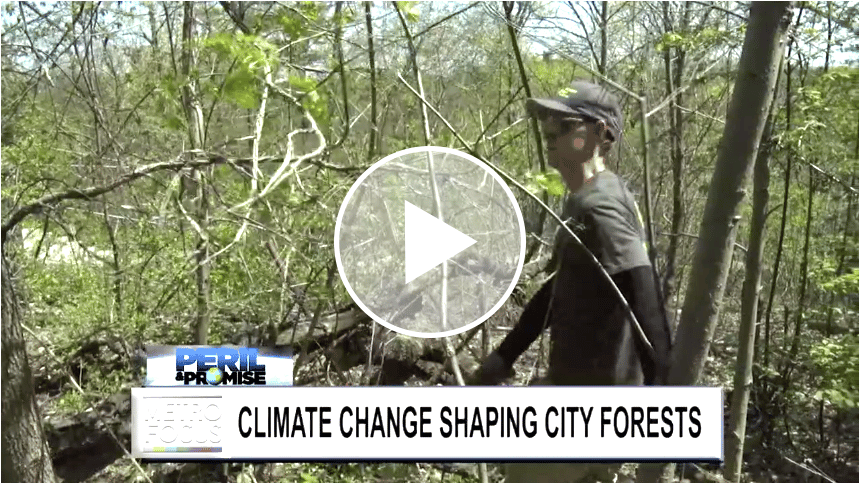
The Alliance’s work to restore the woodlands is also highlighted on the PBS program Metrofocus. View this video below:

Metrofocus Climate Change Shaping City Forests

With respect to the tree survey, a team of arborists from Davey Resource Group, a well-respected urban forestry consultant that has worked extensively in New York City, is collecting data on an estimated 12,000 to 15,000 trees in the Park, representing about half of the total tree population. The inventory will catalog the various attributes of Prospect Park’s trees—species, size and location to name a few. The survey will also include invasive insect, pest and disease detection to help the Alliance in its care of the Park’s trees, “the lungs” of Brooklyn. The inventory will focus on trees in the Park’s landscaped areas. The results of the inventory will help the Alliance, in partnership with the City, strategically maintain and enhance these trees to benefit generations to come.

“By tracking the Park’s trees, the Alliance can better care for these important natural resources, which play a big role in Brooklyn’s quality of life,” said John Jordan, director of Landscape Management at Prospect Park Alliance. “Trees cleanse the air we breathe; reduce the amount of stormwater runoff that reaches the city’s overburdened sewer system; provide shade that helps conserve energy by cooling buildings and paved surfaces; and even help people feel calmer and more quickly heal from sickness.”  

Love Prospect Park? Plant or adopt a tree to celebrate a special occasion or loved one.
 

7 Spring Gardening Tips from Prospect Park Alliance

April 19, 2018

Spring has arrived, and here in Prospect Park, that means plants and flowers galore! Feeling inspired by the flora? We’ve got gardening tips from Prospect Park Alliance’s horticulture crew to help you beautify your surroundings, whether it is your community garden, sidewalk tree pit or other green space.

View Slideshow

Martin Seck

Alliance Transforms Historic Wellhouse into First Composting Toilets in a NYC Park

March 31, 2018

Good news for history lovers…or anyone just trying to find a bathroom. Prospect Park Alliance has restored the Wellhouse, the last remaining building in Prospect Park by Park designers Olmsted and Vaux, into a comfort station with composting toilets—a first for any New York City park.

“It’s a beautiful little building, and it dates back to the time of Olmsted and Vaux in 1869. It’s the only building still remaining from the original park design,” said Christian Zimmerman, Vice President of Capital and Landscape Management at Prospect Park Alliance.

The original purpose of the structure, located by the lake at the base of Lookout Hill, was to pump water to feed the Park’s waterways—its pools, waterfalls and of course the Prospect Park Lake. At the time of creation, it was considered a great technological achievement—an underground viewing platform was created so that Park visitors could see the machinery at work. In the early 20th century, however, the Park was connected to the City water supply, and the Wellhouse became obsolete. Learn more about the history of the Wellhouse on a Turnstile Tour of Prospect Park.

Now, after decades of disuse, the building has being given new life and new purpose by Prospect Park Alliance.

“It is the first time the building has been open to the public in 80 years—it’s pretty exciting,” said Alden Maddry, Senior Architect with the Alliance, on a recent tour of the building.  Composting toilets only use 3 to 6 ounces of water per flush—97% less water than a conventional toilet.  In addition, the project features a greywater garden, which uses water collected from hand sinks, janitor sinks and floor drains to irrigate the landscape.

“The project will save about 250,000 gallons of water a year from going into the city’s sewer system,” noted Maddry.

In addition to the installation of the composting toilets, the $2.34 million project, funded by the New York City Council, provided for the restoration of this historic structure. This included the installation of a new roof, brickwork repairs and—based on historic photos—the recreation of a beautiful portico in period-appropriate colors.

As part of the restoration of the Wellhouse, Prospect Park Alliance excavated the top of the structure’s original cistern wall. As a final phase of the project, the revealed portion of the wall will be cleaned, repaired and capped with bluestone to create a seating area that highlights the history of this distinctive Park structure. In addition, the retaining wall behind the Wellhouse will also be restored. These projects are presented by American Express.

The Wellhouse is just the latest of Prospect Park Alliance’s acclaimed restoration projects in the Park, from the historic Prospect Park Carousel, Boathouse and Bailey Fountain at Grand Army Plaza. “The Wellhouse will perform a vitally needed function, and is vitally important from an historic perspective,” said Zimmerman.

The facility’s permanent residents—thousands of worms—are now busy at work in the composting tanks, and in a few years time, the Wellhouse will produce live-enriching compost. In 2019, the Alliance was awarded the Lucy G. Moses Award for the Wellhouse, an accolade from the New York Landmarks Conservancy in recognition of the owners and stewards of historic buildings across the City who have completed extraordinary restoration and reuse projects.

c. Brittany Buongiorno

Doctor’s Orders: A Walk in the Park

January 1, 2018

Should doctors be handing out prescriptions for a walk in the Park? Increasingly, studies suggest that a dose of nature does a body good. Bestselling author Florence Williams and New York Times health columnist Jane E. Brody report on the science behind what many of us know intuitively: that enjoying the outdoors makes us happier and healthier.

Luckily for those of us who live in Brooklyn, access to nature has been central to the development of our borough over a century. Chartered in 1834,  Brooklyn became the nation’s third largest city within thirty years. The resulting crowds and unsanitary conditions prompted the first American attempts at urban planning, with public green space seen as a health necessity more than an aesthetic one. James T. Stranahan, a business and civic leader, spearheaded the creation of Prospect Park as head of the Brooklyn Parks Commissioners, overseeing the Park’s creation from inception to completion with designers Frederick Law Olmsted and Calvert Vaux. In the early 1860s, Stranahan argued that a park in Brooklyn “would become a favorite resort for all classes of our community, enabling thousands to enjoy pure air, with healthful exercise, at all seasons of the year…”

Today, Prospect Park’s lush 585 acres include 250 acres of woodlands—Brooklyn’s last remaining forest—and also the borough’s only lake, which are sustained by Prospect Park Alliance’s dedicated crews of horticulturalists, arborists and forest ecologists. Anyone who has explored one of the Park’s nature trails, or enjoyed a stroll along the watercourse, can attest to its restorative powers, but what is the science behind this?

For her new book Nature Fix: Why Nature Makes Us Happier, Healthier, and more Creative, Florence Williams traveled across the globe to report on cutting-edge studies that provide concrete links between exposure to nature and health. In one study, an Essex-based environmental economist launched an app that mapped participants’ happiness against their location and found that we are “significantly and substantially happier outdoors…” Further east in Japan, a team of researchers gathering statistical evidence to back up the Biophilia theory, which states that humans experience lower stress levels in nature because we evolved in the natural world. And in Utah, neuroscientists are quantifying how exposure to nature can increase cognitive sharpness and even combat attention disorders.

During her 42 years as the Personal Health Columnist at The New York Times, Jane E. Brody has regularly reported on how a lack of physical activity can cause a host of health issues including childhood obesity, type 2 diabetes, asthma, and vitamin D deficiency. She has linked these issues to a decline in time spent outdoors, warning against the dangers of “Outdoor Deprivation Disorder.” But, according to Brody, the benefits of outdoor activity are becoming more widely acknowledged throughout the medical community, “a growing number of like-minded doctors have begun writing specific prescriptions for outdoor activity.”

The conclusion seems simple–if modern scientific data tells us that getting outside is good for our health, then we should make a point to venture outdoors on a regular basis. In Nature Fix, Williams recommends getting “quick bursts” of the natural world, and where better to do this than in Brooklyn’s Backyard.

Join Prospect Park Alliance and its community partners for a variety of free and low-cost recreation and nature education activities year round. The Park boasts a 3.35-mile path for runners and bikers, the Long Meadow Ball Fields, the Parade Ground, the state-of-the-art LeFrak Center at Lakeside and a year-round Tennis Center. The Alliance also offers more than 800 public programs each year throughout the Park, which engage nearly 75,000 visitors. With so much exciting activity and stunning landscape, it is no wonder that the Park attracts more than 10 million visits each year.


Emerald Ash Borer Discovered in Prospect Park

October 27, 2017

Today, the New York State Departments of Agriculture and Markets (DAM) and Environmental Conservation (DEC) confirmed the first-ever discovery of Emerald Ash Borer (EAB) in New York City in Prospect Park.  Of an initial survey of 10 suspected trees in Prospect Park by Prospect Park Alliance—the non-profit that cares for the Park in partnership with the City, three were confirmed to be infested by this invasive pest by a Cornell University researcher. 

Prospect Park Alliance has removed three trees to date that succumbed to this infestation, located along the Ocean Avenue perimeter of the Park, and additional affected trees in this area will be removed over the winter. NYC Parks, DEC, DAM and Prospect Park Alliance are taking immediate action to limit the spread of infestation and protect New York City’s more than 51,000 ash trees.

“The Emerald Ash Borer infestation was detected in Prospect Park thanks to vigilant monitoring of the tree population by Prospect Park Alliance arborists, a year-round tree crew committed to the protection and preservation of the Park’s 30,000 trees,” said John Jordan, Director of Landscape Management for Prospect Park Alliance. “The Alliance will continue to monitor ash trees in the Park, and will work closely with New York City Parks Department, USDA and DEC to continue tracking and responding to this infestation.”

EAB is a non-native species of beetle whose larvae kill trees by burrowing into the inner bark and thus interrupting the circulation of water and vital nutrients. EAB-infested trees are characterized by thin crowns, sprouts on the trunks of the trees, and the signature d-shaped exit holes adult beetles leave on trees’ bark. EAB only affects ash trees, which constitute roughly three percent of NYC’s street trees. EAB has been present in New York State since 2009.

Governor Andrew M. Cuomo recently awarded a $75,000 Urban Forestry Grant to the Prospect Park Alliance to conduct a tree inventory of Prospect Park. The inventory will include an estimated 12,000 to 15,000 trees in the landscaped areas of the park, representing about half of the total population. The tree inventory will include an invasive insect, pest, and disease detection survey by incorporating the USDA Forest Service early pest detection protocol (IPED).

Help support Prospect Park Alliance’s work to sustain the Park’s 30,000 trees by donating a commemorative tree; becoming a member or making a donation to the Alliance.
 
Additional information about EAB is available on the DEC website.

c. Elizabeth Keegin Colley

Make the Most of Fall Foliage in Prospect Park

October 16, 2017

Fall in Prospect Park is a magical season as the Park lights up in a stunning display of red, orange and yellow foliage. We’ve got you covered with ideas for foliage walks, favorite foliage from Alliance arborists, free nature activities, and some gorgeous fall photography; all to inspire you to get out and enjoy this glorious season in the Park:

Fall Foliage Walks
Prospect Park Alliance has suggested some of the favorite routes through the Park to check out the stunning fall foliage, from the Peninsula up Lookout Hill, from the Nethermead, the Lullwater and beyond.

Facts about Foliage
Why does an oak tree blush red while the ginko glows gold? According to Prospect Park Alliance arborists, the answer is in the very leaves themselves. Plus, the arborists let us in on their favorite fall foliage spots in the Park.

Fall Foliage Slideshow
We’ve rounded up some of our favorite fall foliage photos from past years on Instagram! Take a look to get inspired, then head out to the Park and take your own. Make sure to hashtag your pics with #ProspectPark.

Fall Nature Events in Prospect Park
Want to learn more about the exciting changes the Park experiences during the fall? Join the Prospect Park Alliance for Nature Exploration programs at the Prospect Park Audubon Center, fun for all ages. 

Victor J. Blue for the New York Times

The New York Times Highlights Alliance’s Woodland Restoration Efforts

October 6, 2017

The New York Times gave a fond farewell to Eyebrows, Lily Belle and Swiss Cheese, and the important work these Green Goats performed to help Prospect Park Alliance restore two woodland areas that were hard hit by Hurricane Sandy and other severe storms. This month, the Alliance Natural Resources Crew and volunteers are planting over 20,000 trees, plants and shrubs throughout the Vale of Cashmere, one of the two restoration sites. These native species will help build a healthy forest habitat for birds, wildlife and humans alike. 

Read The New York Times article, and learn more about the Alliance’s work to restore the woodlands.

Lucy Gardner

New Goat Crew Arrives on Lookout Hill

August 15, 2017

As you may have “herd,” the Prospect Park Alliance Natural Resources Crew received some new additions this July. Four new goats, Lily Belle, Eyebrows, Horatio and Swiss Cheese, have arrived on Lookout Hill, a patch of woodlands and one of the highest points in the Park, located behind the newly restored Wellhouse. Like previous goats that have resided in Prospect Park, these four are tasked with clearing vegetation from wooded areas plagued by invasive species in order to make room for native species that will be planted by Alliance staff next fall. These goat, however, are also part of a new research project with the U.S. Forest Service (USFS).

Although the goats are just arriving on the scene, Prospect Park Alliance’s Landscape Management team has been hard at work in this location for nearly a year. Lookout Hill was selected for restoration because of the severe damage storms such as Hurricane Sandy have inflicted on the area, similar to the Vale of Cashmere. The restoration work in both areas is made possible through $1.2 million in funding from the Hurricane Sandy Disaster Relief Assistance Grant Program for Historic Properties, administered by New York State Office of Parks, Recreation and Historic Preservation. Eighty trees on Lookout Hill were either damaged or destroyed during Hurricane Sandy, leaving room for sun-loving invasive species to take over, damaging the ecosystem. According to Mary Keehbauch, the Alliance’s Natural Resources Crew foreperson, the ultimate goal is to “diversify native plant species in a sustainable way.” This means removing the invasives and replacing them with native species without using chemicals or other methods of removal that might harm the local environment.   

In October 2016, a team of Alliance staff partnered with the USFS to perform an initial assessment of the health of the Lookout Hill woodlands. The team was trained by Dr. Rich Hallett, a USFS research scientist, in the protocol for mapping, monitoring and recording the health of forested areas. Throughout the Lookout Hill restoration, the Prospect Park Alliance Natural Resources Crew will continue to monitor the health of the area, and the data collected will be part of a larger effort by the USFS to survey and protect urban forests. During their time in the Park, Lily Belle, Eyebrows, Horatio and Swiss Cheese will be rotated throughout five plots within the area. The health of these “goat” plots will be compared to “goat-less: plots, where Alliance staff will be clearing manually.

The results of this study will help determine the effect that goats have on urban woodlands restoration, and help the Alliance in the future care of the Park’s 250 acres of woodlands. Over the past three decades, the Alliance has invested more than $15 million to restore and revitalize the Park’s woodlands, which were previously in severe decline, including the planting of more than 500,000 trees, plants and shrubs.

Anecdotally, the new herd seems to be nothing short of goat superstars. These goats are younger and less domesticated than previous Prospect Park goats, making them particularly voracious. “They’ve cleared it like champs,” said Keehbauch, “you must come and see them.”  

Prospect Park Alliance

Goats Return to Prospect Park!

May 16, 2017

Back for a second year, Prospect Park Alliance’s beloved herd of goats has returned to the Park as part of the Alliance’s woodland restoration efforts. “It is great to have the goats back to continue their important work,” said Mary Keehbauch, the foreperson of the Alliance’s Natural Resources Crew, which oversees woodland restoration in the Park.

Throughout the Park, storms like Hurricane Sandy felled or damaged over 500 trees, enabling invasive weeds to thrive and overtake the woodlands—harming this fragile ecosystem. In the Park’s northeast corner, where over 50 trees were damaged or destroyed, goats will be working alongside Prospect Park Alliance staff to restore the woodlands, continuing their work from last year. 

“Woodland restoration has always been an important focus for the Alliance,” said Sue Donoghue, Prospect Park Alliance President. “These goats provide an environmentally friendly approach to our larger efforts, and help us make the Park more resilient to future storms.”

Prospect Park Alliance received $727,970 in funding from the National Parks Service through the Hurricane Sandy Disaster Relief Assistance Grant Program for Historic Properties, administered by New York State Office of Parks, Recreation and Historic Preservation. The grant not only funds woodland restoration, but historic preservation work in this landscape, known as the Vale of Cashmere. The Alliance also received an additional grant for work later this summer on Lookout Hill, for a total of $1.2 million in funding.

Goats are prodigious climbers and aren’t picky eaters: they have four stomachs and can consume 25 percent of their bodyweight in vegetation each day. They devour the weeds down to their roots, forcing the plants to use all their energy to grow new shoots, only to be eaten by the goats once again. The goats keep eating until the plants do not have enough energy to grow back at all. When their work is complete, Prospect Park Alliance will plant new native trees and shrubs—red and white oaks, spicebush and service berry—which will help bring back important habitat for birds and other wildlife

The goats, contained behind construction fencing, are provided by Green Goats, a goat farm in Rhinebeck, NY, that specializes in landscape restoration. Of the four-goat crew, only one is from last year’s herd—Max, a black pygmy goat. The other three—named Cinnamon, Swirl and Unicorn—are toggenburgs, a Swiss breed of goat known for their productivity.

Later in the summer, the herd will move to another woodland area of the Park, Lookout Hill, to help restore storm damage in this section of the Park. The goats will eat all the invasive weeds that have overtaken these areas, so that the Alliance can plant new native trees and plants to beautify the landscape and bolster natural habitat for birds and other wildlife, ensuring the Park is more resilient against future storms. 


Francisco Davila

Alliance at Work: Wintertime with the Arborists

February 16, 2017

In these cold winter months, some aspects of Park maintenance go into a state of hibernation, and many Alliance staff members wait patiently and plan for the upcoming spring season. Not so for arborists Francisco Davila and Christopher Gucciardo, who take full advantage of the opportunities afforded by the winter.

“Our job is year-round,” says Francisco Davila, Arboriculture Supervisor for Prospect Park Alliance, “and every season brings its own set of tasks.”  Prospect Park Alliance arborists have a big task set for them in the care and maintenance of the Park’s more than 30,000 trees, which represent more than 200 species. This is Brooklyn’s last remaining forest, and it is an important wildlife habitat that supports more than 250 species of birds, and countless other creatures.

So what exactly does an arborist do during this chilly time of year? “During the winter we focus on tree pruning and assessments. Since trees are without leaves, winter does provide us the luxury to very quickly spot issues such as cracks, rubbing branches and of course dead limbs. Winter is also a great time for us to scout and plan the future of our canopy by selecting planting sites for our Commemorative Tree Program.”

During this season, it isn’t uncommon to happen upon Davila and his crew taking down tree limbs or removing a tree altogether. So why are they doing this? “Being in a historic park such as Prospect Park we have a lot of beautiful mature trees. We are never happy to remove trees but when we do, it’s because of warranted reasons,” said Davila. When his crew or a Park visitor spots a damaged or unhealthy tree, they assess the situation, “we try to evaluate the tree’s integrity and potential risks to determine if we are going to remove it. The same goes for tree limbs. In making these decisions, overall safety always comes first.”

One of the most fun aspects of winter work for an arborist? “The new views you get from the canopy,” says Davila. “Since the trees have lost their leaves, when you are climbing you get new vast unobstructed views. It’s awesome.”

The life of a city tree is never an easy one, but the Alliance arborists work year-round to keep these Park residents happy and healthy, so next time you take a walk in the Park, look up! You might just see an arborist taking in the view.

Learn more about the Commemorative Tree Program.