c. Paul Martinka

Prospect Park’s New Freeze-Resistant Fountains

November 23, 2018

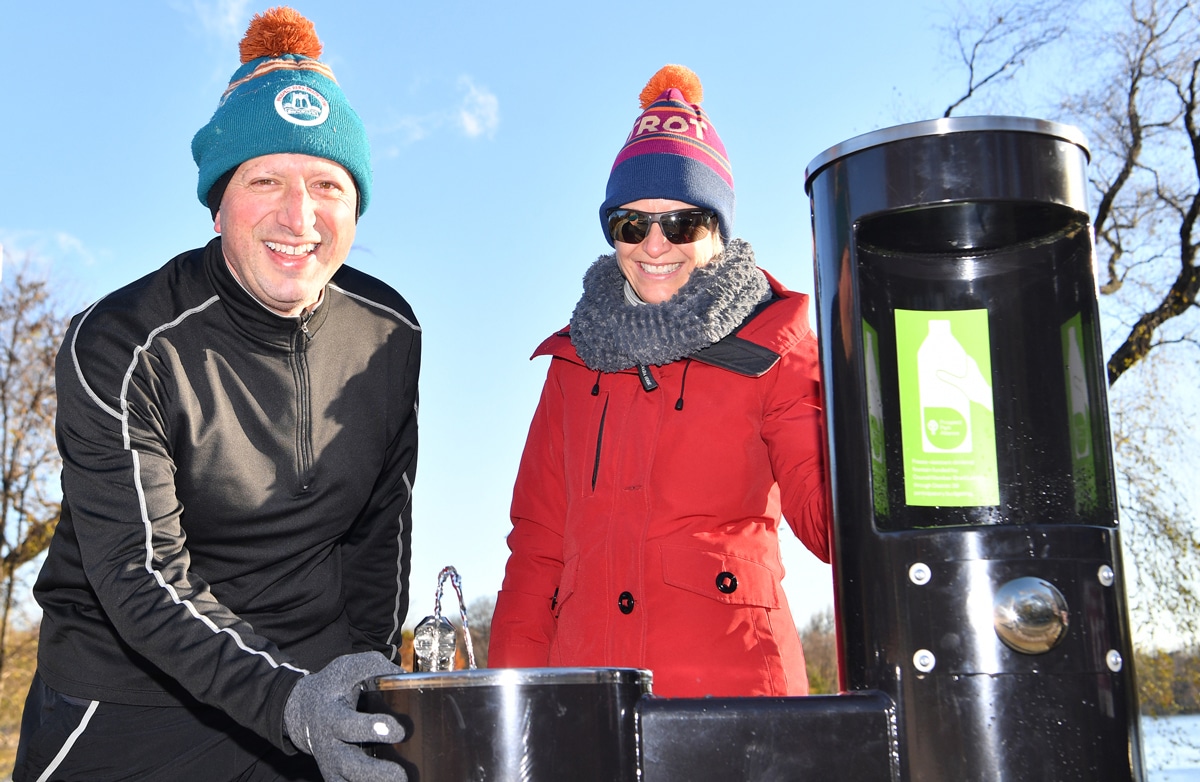
Runners rejoice! On Thanksgiving morning, November 22, 2018, New York City Council Member Brad Lander joined Prospect Park Alliance President Sue Donoghue for the inaugural gulp from the park’s new freeze-resistant drinking fountains. Council Member Lander funded this $175,000 project through the District 39 participatory budgeting initiative that has enabled the Alliance to install four fountains along the Prospect Park Drive that are freeze-resistant and available through all four seasons.

fountain-lander-martinka.jpgCouncil Member Brad Lander and Alliance President Sue Donoghue try out the new freeze-resistant fountain. c. Paul Martinka
The event took place on Prospect Park’s lakeshore, moments before the Prospect Park Track Club’s annual Turkey Trot, which took place this year in historic sub-zero temperatures. Prospect Park offers miles of roadways and paths for serious and recreational runners and walkers, including the park’s 3.36-mile running lane along the Park Drive.

“I’m thrilled that the freeze resistant water fountains, a 2016 participatory budgeting project winner, are finally up and running in Prospect Park,” said Council Member Brad Lander. “The many runners, cyclists, and walkers who exercise in the park during the winter months will now be able to hydrate even in the coldest weather! Huge thanks to the Prospect Park Alliance for their help in seeing this project through.”

Due to problems posed by frozen pipes, traditional city drinking fountains are turned off during much of the fall and winter months. This leaves the multitudes of Prospect Park’s runners, walkers and visitors without a source of drinking water in the park.

The year-round fountains’ plumbing is located more than four feet underground—below the “frost line,” where the water is well insulated and does not freeze. Each time the fountain is used, the water drains all the way back down, preventing frozen pipes. This feature necessitates that users hold the button down for a few additional seconds than at a traditional fountain, giving the water time to make it up to surface-level.

A total of four new year-round fountains will grace the Park Drive—two entirely new fountains near the Garfield Street Entrance and the Vanderbilt Street Playground, as well as two retrofitted existing fountains near the Parkside entrance and the Ballfields. 

Prospect Park Alliance is the non-profit organization that operates the park in partnership with the City. We provide critical staff and resources that keep the park green and vibrant. Through the end of 2018, support the park and your donation will count double thanks to a matching challenge.

Learn more about projects in the park on our Capital Projects Tracker.

Ladybugs to the Rescue

November 13, 2018

First goats, now… ladybugs? Prospect Park Alliance is always on the lookout for innovative and environmentally friendly ways to sustain the park. In recent years, this meant a crew of goats to clear invasive weeds, and this past summer it meant the introduction of tens of thousands of ladybugs to combat a new challenge: lace bugs.

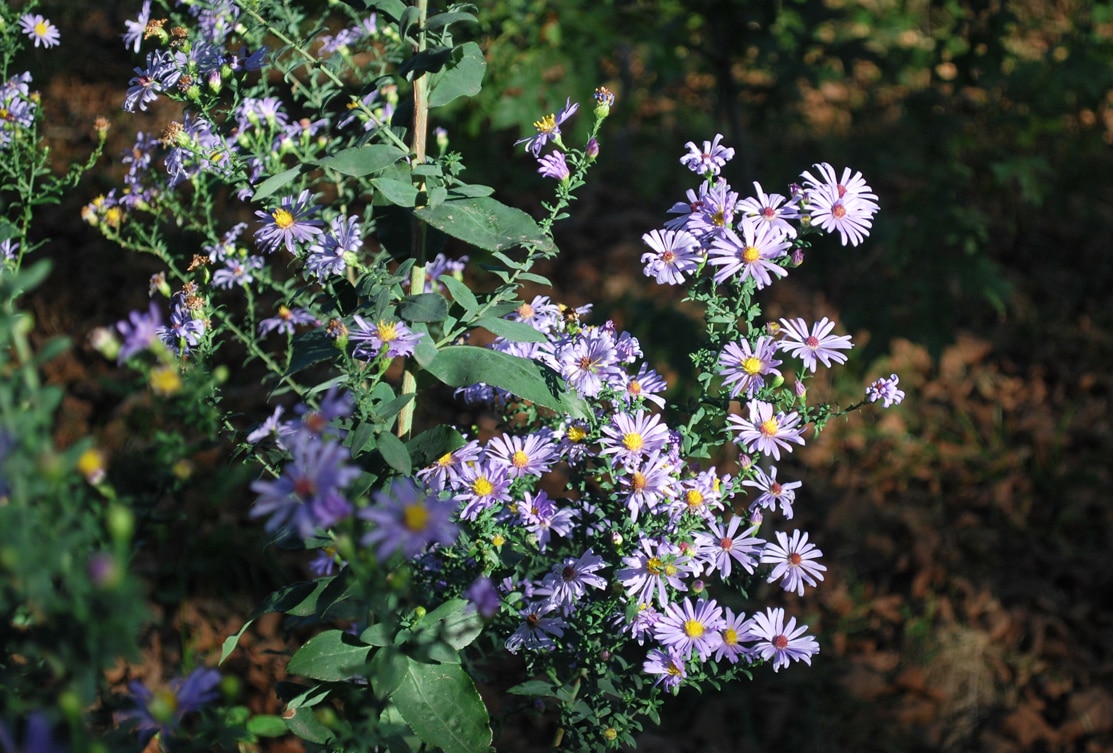
“We noticed that the asters were dying,” said Allie Loux, Prospect Park Alliance Assistant Gardener at the LeFrak Center at Lakeside. “They were turning yellow and brown and covered in these little dots.” Asters are an important perennial species and one of the most common flowers in Prospect Park, often sporting purple or white flowers. Lakeside’s aster plants had been hit with a lace bug infestation. These miniscule insects feed on the leaves of flowering plants and shrubs, and in high concentrations they can spell disaster for plants.

Alliance gardeners needed to find a solution to their lace bug problem, and wanted an alternative to traditional pesticides. “Lakeside is very wild,” said LJ Philp, Alliance Lead Gardener at Lakeside, “and when you’re spraying chemicals, you’re going to hit something else.”

aster.jpg

Aster plants in Prospect Park, photo courtesy of Christian Zimmerman, Prospect Park Alliance Vice President of Capital and Landscape Management 

While Prospect Park’s 585 acres may seem wild, this green space is a carefully cultivated ecosystem, and the Alliance’s crews avoid introducing chemicals whenever possible. Loux added, “when we use toxic chemicals, it’s getting in the air, in the water, harming our bodies as well as the animals and the plants. Maybe a pesticide will get rid of the lace bugs, but it will also probably kill something else.”

Their first course of action was to test neem oil, a natural pesticide derived from the neem tree. When they realized the necessary quantity of the oil would be prohibitively expensive and application would be time consuming, the gardeners got creative.

“Integrative pest management practices (the broad-based approach that integrates practices for control of pests) suggested finding a natural predator,” said Philp, “and ladybugs seemed like a great fit.” Introducing ladybugs, an insect not found in great quantities in the park, could be a tactic for managing the lace bug infestation while avoiding harmful chemicals, and sparing staff hours. “We did our research and weren’t worried that the ladybugs would out-compete other species or take over, so we decided to give it a try.”

In July, the gardeners, including Uriel Walker (formerly an Assistant Gardener at Lakeside) received their shipment of ladybugs, 72,000 for a grand sum of $150, and dispersed them in locations around Lakeside. They even left them with damp cardboard boxes smeared with honey (food and lodgings). “We wanted them to feel like they were in a safe place,” said Philp.

So, was this experimental treatment a success? “The lace bugs went away,” said Philp, “it worked!” In just a few short weeks, the infestation had cleared and the asters revived. In finding a creative solution, these Alliance gardeners preserved one of the park’s natural habitats, and added a few thousand lucky bugs to the ecosystem in the process.

Learn more about how Prospect Park Alliance sustains the park environment.

c. Martin Seck

Fall Things to Do in Prospect Park

October 17, 2018

Prospect Park’s most colorful season has arrived, and  Prospect Park Alliance has plenty of ideas of how visitors of all ages can enjoy this time of year in Brooklyn’s Backyard. Here is our checklist for autumnal fun in Prospect Park, get out and experience it all!

  1. Take a fall foliage walk! Check out some of our favorite routes through the park to see  the stunning colors of autumn, from the Peninsula to Lookout Hill, the Nethermead, the Lullwater and beyond.
  2. Bid adieu to the birds. Fall is migration season in Prospect Park, with hundreds of species of birds stopping through these 585 acres on their way to their winter homes. Read our tips for birdwatching in Prospect Park, and check out upcoming bird walks you can join!
  3. Strap on your skates because starting October 26, the LeFrak Center at Lakeside is open for ice skating, hockey, broomball and curling. Enjoy these wintertime activities surrounded by the picturesque autumn colors, and before the arctic weather sets in!
  4. Learn more about nature at the Prospect Park Audubon Center. Prospect Park Alliance presented free nature activities Thursday through Sunday in October, and Saturday and Sunday in November and December. Take a birdwatching walk, introduce your  child to the creatures that creep, crawl and fly in the park. Plus, pick up ready-to-go Discovery Packs filled with nature activities for families!
  5. Go for a run. Ready to break a sweat? Fall is the perfect time to go for a run in Prospect Park and admire the colorful foliage from the park’s 3.36-mile loop, not to mention the paths that run through the natural areas of the park. Prefer an indoor activity? The indoor tennis season kicks off October 22 at the Prospect Park Tennis Center. Sign up for a seasonal court or lessons today.

Prospect Park Carousel is a Treasure of New York

September 18, 2018

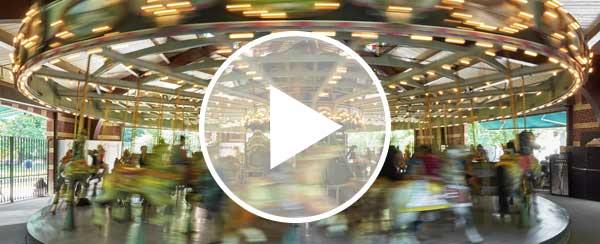
Prospect Park’s historic Carousel was recently a feature of THIRTEEN’s Treasures of New York, highlighted as an “Historic Gem in Brooklyn.” The segment tells the history of carousels in Prospect Park, including the current carousel, which was built in 1912 by one of the foremost carousel designers of the day, Charles Carmel. It came to the park in 1952, but fell into disrepair in the 1970s. In 1990, the newly formed Prospect Park Alliance—the non-profit that sustains, restores and advances the park—undertook the restoration of the Carousel in an effort to return this landmark to its original glory. The project was a great success, and today the Carousel and its 53 hand-carved horses (plus assorted dragons, giraffe and deer) is just one of the many attractions that draws millions of visitors to the park each year.

Watch the video feature: 

carousel_video.jpg

Today, the Carousel is one of Prospect Park’s most popular venue for children’s birthday parties! Learn more about having your next party at this beloved landmark. 

c. Elizabeth Keegin Colley

The Results Are In! Prospect Park Tree Survey

September 14, 2018

Prospect Park is an arboreal wonderland! Through a $75,000 Urban Forestry Grant from the New York State Department of Environmental Conservation, Prospect Park Alliance recently surveyed roughly 12,000 of the park’s 30,000 trees as part of its work in caring for the Park’s natural areas.

The survey not only provides a more nuanced picture of the park’s evolving ecosystem, but important insights into the economic, environmental and health benefits of Brooklyn’s Backyard. Conducted by Davey Resource Group (DRG), a well-respected urban forestry consultancy that has worked extensively in New York City, you can examine the results on the Prospect Park TreeKeeper Interactive Map.

“The survey has provided exciting insight into what we already knew were some of the park’s most important treasures, its trees,” said Prospect Park Alliance President Sue Donoghue. “We are all aware of how special this urban green space is, but now with this data we can quantify the economic benefit our community receives from these trees. It clearly reinforces just how precious this resource is, and how we must all do our part to care for it.”

During the survey, arborists inventoried trees primarily in the landscaped areas of the park, a total of 12,414 trees. Among the findings:

  • The surveyed trees provide more than $1.5 million in annual environmental benefits. This includes:

    • Air quality: 24,000 pounds of pollutants removed from the air each year, valued at $125,000;

    • Greenhouse gas benefits: 3,000 tons removed from the air, valued at $17,000;

    • Energy benefits: equivalent to 1,000 megawatt hours saved, valued at close to $700,000;

    • Storm water runoff benefits: 21 million gallons saved from the city sewer system, valued at $172,000.

  • There is a plethora of trees to be found in the park, including the 84 genera and 193 species represented in this survey. This includes numerous varieties of native cherries, maples and oaks, representing 41% of the trees surveyed, as well as less common species included the Southern magnolia, a fragrant, flowering tree whose northern range is growing due to climate change, and the bald cypress, which typically grows in swampy conditions and sends up knobby root growths called “knees.”

  • The largest tree surveyed has a diameter of 77 inches, or 6 feet, 5 inches across! This specimen tree, an American elm located near the Bandshell, is estimated to be over 100 years old.

  • The inventory also identified challenges faced by the park’s trees. The overall condition of the inventoried tree population is rated fair, however, 8% of the inventoried trees had stress caused by humans.

  • Emerald ash borer, an invasive beetle, was detected in the park’s ash tree population. And, though they have not been detected in Prospect Park, Gypsy moths and Asian Longhorn beetles pose the biggest threats to the health of the inventoried tree population.

  • A tree survey metric, “replacement value,” describes the historical investment in trees over time. The surveyed park trees have an estimated replacement value of more than $59 million!

In completing this report, DRG put together a Prospect Park Tree Management Plan, charting out the tree maintenance and planting needs in the park for the next five years. “By tracking the park’s trees, the Alliance can better care for these important natural resources, which play a big role in Brooklyn’s quality of life,” said John Jordan, Director of Landscape Management at Prospect Park Alliance.

There is a long way to go for Prospect Park Alliance to keep this vital community resource healthy and safe. Contributions from community members help sustain the park’s trees and fund the Alliance’s team of arborists and natural resources crew.

One way to support this important work is through the Alliance’s Commemorative Giving Tree Program. During planting seasons that take place each fall and spring, members of the community have the opportunity to plant a new tree in Prospect Park. Through this program, roughly 1,100 trees have been planted over the past 30 years. Each year, the Alliance plants a community tree on Arbor Day: learn more about how to get involved in this community celebration.

Want to learn more about Prospect Park’s trees? Check out the Prospect Park TreeKeeper Interactive Map to get info on each of the surveyed trees and their benefit to the community.

Take a Run in Prospect Park

September 12, 2018

Prospect Park is an amazing destination for runners and walkers, right in Brooklyn’s Backyard. 

Prospect Park features a 3.36-mile running lane along the Park Drive, which went car-free in 2018. The park’s 585 acres feature miles of trails and pathways that transverse hills, meadows and even picturesque waterways, maintained by Prospect Park Alliance, the non-profit organization that provides critical staff and resources that keep the park green and vibrant. This varied landscape is the perfect place to test your mettle and push yourself in your next run.

“Prospect Park is a great change from the crowded Central Park,” says Steve Mura, manager of runner training & education at New York Road Runners and also an NYRR Group Training coach in Prospect Park. “The 3.36-mile Park Drive loop offers a change of terrain as well as scenery,” says Mura, “and you can further change it up by cutting through Center Drive or Wells House Drive.”

Want to train on a trail less traveled? “There are some great trails in the park that will loop you around the inner area,” says Mura. “Get lost trying to find some historical area of the park, like Lookout Hill, the highest point in the park, with great views of Brooklyn—you might even be able to see Coney Island; Harry’s Wall, which honors Prospect Park Track Club co-founder Harry Murphy; and Cleft Ridge Span, a decorative concrete arch that dates back to 1872.”

Ready to push yourself? “That Battle Pass hill is a challenge! Run by effort,” advises Mura. “Your pace will slow down, but that effort level should stay the same. On the downhill, watch your effort. You want to stay controlled down the hill and stay in your rhythm.” 

Ready to get out in the park? Take a look at Prospect Park Alliance’s downloadable running map with mileage and distances in Prospect Park, then check out NYRR’s 3-mile Prospect Park running route, which passes 10 different points of interest in the park. For everything else, head to prospectpark.org/running.

The Alliance’s Growing Greenhouse

August 14, 2018

This year, the Prospect Park Alliance horticultural crew dug in and got their hands dirty in order to make an exciting new addition to their team: a greenhouse. The existing structure, located in the park’s Garage Compound space for maintenance and operations, had last been used for this purpose roughly 20 years ago, and had served as storage in recent years.

The resurrection of the greenhouse was primarily undertaken by LJ Philp (Lead Gardener at the Lefrak Center at Lakeside), Uriel Walker (Assistant Gardener, Lakeside) and Allie Loux (Assistant Gardener, Lakeside), with the intention of creating a facility for Alliance gardeners to learn, experiment and move Prospect Park towards greater self-sufficiency and resiliency. 

With 19 variations of native species of plants, including grasses (Virginia wild rye, Little bluestem and Purple love grass) and broadleaf flowering plants (Black-eyed susan and Beardtongue foxglove), the three gardeners, along with the support of other Alliance staff, have nurtured the greenhouse back to life.

The undertaking required carpentry work (including the creation of roll-up sides for ventilation, meshing for shade, and a sliding door to combat heavy winter snow), as well as the installation of a misting irrigation system. The seven-month-old greenhouse is bursting with life and ecological lessons. 

The trial of learning how to grow these specific native plants from seed has proved to be a hands-on process of “positive trial and error,” says Philp. By supplementing the plants purchased at a nursery with home-grown additions, Prospect Park Alliance gardeners can better understand the full lifespan of Prospect Park’s plants and move towards self-sufficiency.

These native plants will not only live longer and thrive with less care, but they will also serve as a greater addition to the park’s ecosystem: providing food and habitat for native wildlife and pollinators and enhancing the park’s resiliency to help it thrive for years to come. 

The project is still young, and the team has bright eyes for the possibilities it can bring to Brooklyn’s Backyard.

Learn more about the Alliance’s work to sustain the Park’s environment.

Celebrate Brooklyn’s Diverse Cultures at the Brooklyn Roots Festival

July 13, 2018

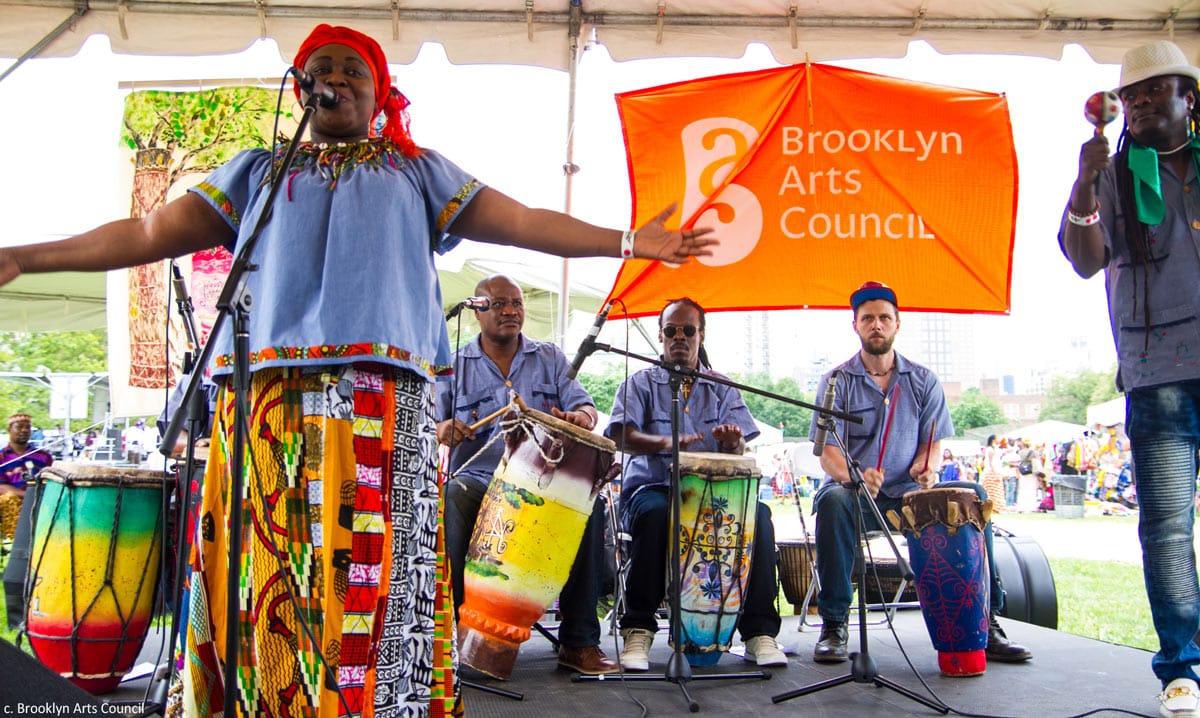
Pictured above, Afro-Puerto Rican drum and dance ensemble Bomba Yo. C. Brooklyn Arts Council.

On July 29, the Brooklyn Arts Council (BAC) and Prospect Park Alliance present the Brooklyn Roots Festival. This folk arts festival celebrates Brooklyn’s traditional artists and immigrant communities through performances, workshops, family activities and more.

This event is free, RSVP today to let us know you are coming!

RSVP-btn-orange.png

The festival is part of BAC’s summer-long Tradition as Resistance Festival. “Folk and traditional expressions are not relics,” said BAC Folk Arts Director Christopher Mulé. “These communities have much to teach us about moving forward in our current climate of social justice and protest. The Brooklyn Roots Festival provides a platform for multiple generations to celebrate traditions of resistance with pride.”

“Prospect Park is Brooklyn’s Backyard, and a haven for the diverse communities of this borough,” said Prospect Park Alliance Vice President of Programs Maria Carrasco. “The Alliance is dedicated to providing free public programs that celebrate the history and traditions of Brooklyn, and we are thrilled to partner on this first Brooklyn Roots Festival.”

The festival’s Main Stage will feature Palestinian dance ensemble Freedom Dabkah, Haitian drumming group Fanmi Asòtò, Afro-Puerto Rican drum and dance ensemble Bomba Yo, and other groups representing Yiddish, Serbian and African Diaspora cultures.

fanmi_asoto_bac.jpg

Pictured, Haitian drumming group Fanmi Asòtò. C. Brooklyn Arts Council.

In addition to the performance Main Stage, a workshop station will engage audiences with activities led by groups including the Queer Kitchen Brigade, the food-agro project working in solidarity with Puerto Rico’s sustainable agroecology movement; Gran Bwa and the Congo Square Drummers, sharing their longtime tradition of sharing tradition and ritual in the Prospect Park Drummer’s Grove; and dance and music workshops.

A children’s section at the Lefferts Historic House presents acclaimed “King of the Dance Party” Father Goose Music with a journey through Caribbean and multicultural music, East Asian folk children’s group Rabbit Days and Dumplings featuring Elena Moon Park, and puppetry presentations by the Czechoslovak-American Marionette Theatre. City Lore is also partnering with BAC to present the multimedia theater piece What We Bring: Stories of Migration.

This event is free, RSVP to let us know you are coming!

Pictured at top, Afro-Puerto Rican drum and dance ensemble Bomba Yo. In story, Haitian drumming group Fanmi Asòtò. C. Brooklyn Arts Council. 

c. Martin Seck

City Funds Park Improvements

July 2, 2018

News Body Text

Amanda Gentile

PPA Profile: Mark Anthony’s 25 Years at the Alliance

June 20, 2018

This June, Prospect Park Alliance marks a staff milestone as Mark Anthony, the supervisor of our Natural Resources Crew, celebrates 25 years with the Alliance, the non-profit that cares for the park. When Mark joined in the early 1990s, the Alliance was only seven years old, just beginning to make its mark in the revival of these vast 585 acres. We sat down with Mark to catch up on the changes he has seen in the park and his reflections on 25 years.

Congratulations on 25 years at Prospect Park Alliance! How did you begin your work with the Alliance?

I grew up in Brooklyn, and came to the Alliance through a program called the City Volunteer Corps, an organization that took inner-city kids and placed them in jobs that helped clean up the city. I started in a horticultural position, and after six months and an exchange program in Washington, D.C., I took a seasonal horticultural position at the Alliance. I started learning the trade from there, pruning and taking care of trees. I also got a second seasonal position working at the old ice skating rink in the winters. I switched back to horticulture in the summer, doing woodland work, and going back and forth, until the Alliance hired me full-time to work in the woodlands.

What were the woodlands like in 1994?

It was decrepit and a mess; it was unsafe to go through. You didn’t even know the woods were there because there was a vast amount of erosion, graffiti and garbage: you couldn’t figure out what was what. The trees there were mostly invasive species, there were no native trees where wildlife could thrive. That was the main reason we created the Natural Resources Crew, to bring back the habitat, diversify the woodlands, and make it better so people could use the park.

Have you seen the results of your work in the park?

Our work in the woodlands—the Ravine, Midwood, and Lookout Hill—helped mark the boundaries, to show “here are the woodlands, here is a path”. We restored the habitat, rebuilt slopes, planted native species. We restored the waterfall in the Ravine. It was underground, so we had to dig it up and get the water flowing through it again.
Our work has been successful. Certain bird species come through the park that we hadn’t seen in years. Chipmunks are back in the park, I don’t know where they went but they’re back now, the population is growing. We have owls and Red-tailed hawks, egrets that nest here and continue to come back each year. And the people are enjoying the park, too. They’re enjoying them too much, but you can’t fault them for that. That’s the reason we do the work, it’s people’s habitat too.

What do you enjoy about this work?

My job is a different than it used to be when I first joined the Alliance. I’m supervising the work of a crew, but I still get a chance to get my hands dirty. I go out and push the mower, push the weed-whacker, and even that is gratifying. You transform the area, make it visible and safe, and now people can actually use it. There’s gratification in seeing your labor and hard work put into this place. Seeing trees I planted that are surviving, some 15-feet tall. Seeing landscapes I worked on a long time ago, and they’re still thriving. This is something that is part of what I need to be doing: giving back to nature, people and the world.