c. Radka Osickova

Spot the Park’s Newest Species: The Devil Bird

May 11, 2023

For the past few weeks, an unusual visitor has been perched in the treetops high above Prospect Park’s lake. The Anhinga, also known as the Devil Bird, is a large waterbird with a snake-like neck that is typically found in the swampy southeastern corner of the country. But, for the first time since 1992, the bird has been spotted in New York—right here in Brooklyn’s Backyard.

Located along the Atlantic Flyway, with more than 250 migratory and resident bird species spotted each year, Prospect Park is a long beloved birdwatching haven. “The park’s 585 acres are a critical life-saving space for birds. Prospect Park is a rest stop full of food and water thanks, in part, to Prospect Park’s lake and watercourse,” says Peter Dorosh, a Prospect Park Alliance Eco Zone Gardener and avid birder who recently spotted the Anhinga himself. “Prospect Park was the lucky beneficiary of such an awesome sighting: Brooklyn’s only lake  caught the Anhinga’s eye.”

For members of the birdwatching community, this is an exceptional spotting outside its usual migratory path (which for the Anhinga historically reaches as far north as the Carolinas). The bird’s arrival was so unexpected, it was even featured in The New York Times.

For Dorosh and Prospect Park Alliance’s crew of Eco Zone Gardeners and Forest Ecologist, which works to restore and sustain the park’s natural areas, the Anhinga’s arrival highlights an important aspect of their job: ensuring the park’s landscape is a healthy breeding and foraging habitat for birds and other wildlife—both expected and unexpected.

“Birds stop in, refuel, rest and then continue onward for the greater breeding territories in the northern United States and Canada,” explains Dorosh. To Dorosh and Prospect Park Alliance, the priority is ensuring the birds find what they need to thrive in the park. “It’s important to plant native trees and shrub species because these plants attract insects—particularly moths and caterpillars, as they are the soft food needed to feed baby birds and fledglings,” he says.

The Alliance also focuses largely on mitigating habitat loss. “We do our part to remove the invasive plants and replace them with native plants,” says Dorosh. “This greatly benefits natural habitats and restores food webs that include the pollinating wildflowers, grasses and fruiting shrubs that are essential for insects.”

The team strives to create and maintain habitats that send the right signals to any new bird species that may unexpectedly arrive due to the changing climate. “Birds know if a breeding territory will ensure the survival of their species,” Dorosh says. “If we have enough native trees, birds will coexist with other birds and become specialized in what they eat—that’s how evolution intended it.”

As anyone familiar with the variety and abundance of species in Prospect Park knows, there’s plenty to go around. “Warblers and flycatchers eat insects. Cardinals and Blue Jays eat berries and nuts. Sparrows eat grass seeds, and Hawks are carnivores who help keep the rodent population at bay,” explains Dorosh. “We have it all in Prospect Park, as long as we maintain the habitats to become and stay healthy and native.”

Interested in catching a glimpse of the Devil Bird? Learn about bird watching opportunities in Prospect Park.

Learn more about Prospect Park Alliance’s work to sustain the environment and how you can help support the plants, wildlife and community of Brooklyn’s Backyard.

Must See Spring Bloom Destinations

April 4, 2023

Spring is here in Prospect Park, and Brooklyn’s Backyard is flourishing with flowering cherry blossoms, vibrant witch hazel, peach and white magnolias and more. To help you make the most of the season, we’ve compiled a guide of our top bloom destinations throughout the park, with both hidden treasures and classic favorites.

Mary Keehbauch, Deputy Director of Landscape Management at Prospect Park Alliance, shares how the team is taking in the change of season and planning for what the upcoming months will bring, more specifically in the park’s 250 acres of woodlands. “We are collectively taking this time to scout and be inspired by the returning forces of nature,” said Keehbauch. “As yellow trout lilies and wildflowers such as trillium push through the leaves and vines, our team will clear the way for blooms to come. We welcome park visitors to stroll the chip lined trails in our woodlands, and watch as the transformation begins, assisted by the April showers, extended hours of soil-warming sun, and our hardworking team supported by wonderful dedicated volunteers.” As you admire the blooms of Brooklyn’s Backyard, remember to leave petals, leaves and berries on trees and flowers. These are essential to the pollinators and wildlife that call Prospect Park home, and by making the most of spring from a safe distance, you’re helping our ecosystem thrive.

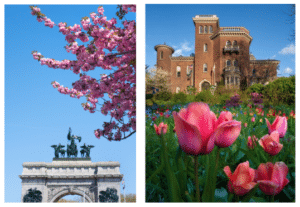
Spring blooms at Grand Army Plaza and vibrant hues of Carmen’s Garden in front of the Litchfield Villa. c. Martin Seck + Michael Silverstone

Grand Army Plaza

Grand Army Plaza is Prospect Park’s formal entrance, and features some of the park’s most impressive architecture, and ornamental flowers and trees. Among them, early-blooming cherry trees and daffodils are the first to arrive. April welcomes Eastern redbud and pink-flowering cherry trees that give way to the white Silverbells in May. As summer approaches, watch for the clustered flowers of the bottlebrush buckeye.

LeFrak Center at Lakeside

At Lakeside, the spring blooms attract park visitors and wildlife alike! Park goers who visit the greenroof at Lakeside in early spring will be able to catch the vibrant yellows, oranges and reds of Witch Hazel. As April advances, Lakeside receives a fresh coating of delicate white blossoms from the many Serviceberry, Chokeberry, Cherry laurels, and Foxglove Beardtongue that are buzzing with activity, as well as blooms of yellow from the Fragrant Sumac and Spicebush. Late spring brings with it a crescendo of flowering dogwoods and dewberries, and those with a keen eye might just spot a few of the subtle, deep purple blossoms of Lakeside’s paw paw trees!

Litchfield Villa

The historic Litchfield Villa is a well-known destination for flower lovers. In April, tulips and Juneberries electrify Carmen’s Garden, located directly in front of the pre-Civil War-era mansion, heralding the arrival of warm weather. In May, blossoming crabapple and hawthorn trees paint the landscape in pinks and whites, while perennial displays replace the fading tulips. Be sure to head around back to see cream-colored flowers of the Korean dogwood trees.

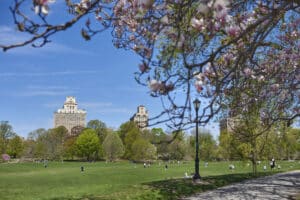
Magnolia trees in bloom along the Long Meadow in Brooklyn’s Backyard. c. Martin Seck

Long Meadow

Passing through the Meadowport or Endale Arch in mid-April, visitors are welcomed by the peach and white bouquet of magnolia and dogwood trees that line the Long Meadow’s north end. The warmer weather brings out lilacs, as well as the hanging flowers of the yellowwood tree.  Later in the season, enjoy the view under the shade of a flowering linden tree, and take in the sweet scent of the oakleaf hydrangea near the Picnic House.

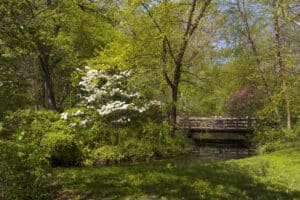
Flourishing woodland flowers in Prospect Park’s woodlands. c. Martin Seck.

Ravine

Those with an adventurous spirit should head across Binnen Bridge and past the Nethermead to the Park’s woodland Ravine. Look for spicebush with its clusters of yellow flowers and small red fruits that are rich in nutrients for small birds. Pond edges are home to chokeberry, and American elderberry, deciduous shrubs native to New York. These shrubs will later feature berries that attract a variety of wildlife, making them instrumental in the health and diversity of Prospect Park’s natural habitats. Watch for the rare and lively Pinxter azalea which will add a vibrant pop of color to the evergreening woodland areas.

Bartel-Pritchard Square

Prospect Park is home to a few dedicated pollinator  gardens. In addition to Grand Army Plaza and Carmen’s Garden, Bartel-Pritchard Square features a variety of springtime blooms. The arching Carolina allspice with its unique maroon flowers that smell of strawberry anchor the native pollinator friendly beds, and it’s hard to miss the old-fashioned weigela, an ornamental shrub with beautiful trumpet-shaped lavender flowers.

Plan your visit to Prospect Park. 

c. Mary Keehbauch

Solar Innovations Take On Invasive Plants

February 7, 2023

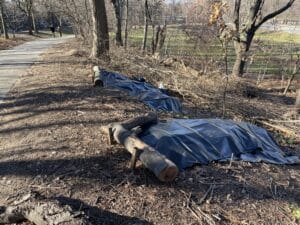
Have you spotted plastic tarps in certain areas of the park and wondered why? Fear not–they’re not picnic remnants or litter left behind. The tarps are an eco-friendly approach to fighting invasive plants without the use of harmful chemicals. It’s just one of the many ways that Prospect Park Alliance’s Landscape Management team has deployed environmentally friendly and innovative approaches to keep the park’s natural areas green and vibrant; including the use of goats to clear invasive weeds, ladybugs to tackle a harmful insect infestation, and layers of cardboard and mulch to ward off opportunistic plants of concern.

This season, the team has been hard at work implementing a technique called solarization to help keep the park’s landscape healthy and resilient with strategically placed sheets of plastic.

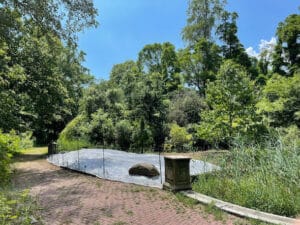
Solarization at work at the Children’s Pool in Prospect Park

Solarization at work at the Children’s Pool in the Northeast corner of Brooklyn’s Backyard. Photo courtesy of Mary Keehbauch.

The team charts out a customized approach based on the specific needs of each landscape. “The plastic color and thickness is determined by the location and the target plants. Is it sunny or shady? Upland or near the watercourse?  Is it a small enough area that we will be successful with this method? How will it look or impact the experience of park users?” says Mary Keehbauch, Prospect Park Alliance’s Deputy Director of Landscape Management, on the meticulous planning behind this method. “Often, the invasive plants that are targeted would be nearly impossible to eradicate using traditional manual methods. Solarization is an opportunity to reclaim small target areas, causing less disturbance and, eventually, a lot less labor.”

Solarization at work protecting Prospect Park's natural landscapes.

Because of these shrub stumps’ location at the top of a steep slope, the team used solarization to avoid destabilizing the slope with digging. Photo courtesy of Mary Keehbauch.

At the onset, solarization is an intense labor of love and requires an area to either be completely cleared of all organic material, or in the case of the tall reeds near the lake, flattened with plywood. “Thankfully, we have very willing and devoted volunteers and staff that help prepare and install the appropriate type of plastic,” says Keehbauch. Thanks to the hard work of these staff and volunteers, native plants have been successfully reintroduced to the south Lakeshore area and parts of the Lullwater.

The solarization of a given area can span anywhere between two months to two or more years, and, while restoration will be ongoing, this technique has already helped slow the growth and minimize the presence of invasives in the park. Once an area is cleared or flattened, the team uses either black or white plastic to reap the benefits of solarization. Black plastic is used to block light and heat the roots of an invasive plant once it has been cut down, while clear plastic is used in areas of direct sunlight to stop the plant’s growth, heat up the soil to destroy the roots and rid the soil of any remaining seeds. The end result is soil that is ready to be planted with native, pollinator-friendly plants that will help Prospect Park’s ecosystem thrive.

The technique is currently underway in multiple areas in Brooklyn’s Backyard and is focused on suppressing Amur Honeysuckle (Lonicera maackii), Goutweed (Aegopodium podagraria) and Common Reed (Phragmites australis). All three of these invasive plants spread quickly and form dense clusters that can outcompete and eventually replace the park’s native plants. This work allows native plants to grow and thrive, which promotes the longevity of Prospect Park’s landscape and helps protect the habitat of the countless wildlife that call the park home.

Keep an eye out for the innovative ways Prospect Park Alliance works to tackle invasive plants throughout the park and learn more about how the Alliance is sustaining the environment. 

10 Years After Sandy in Prospect Park

November 10, 2022

It has been 10 years since Superstorm Sandy arrived in New York City, taking lives and leaving a path of destruction in its wake. As Brooklyn residents at the time will remember, Prospect Park was extremely hard hit by the storm and the work to recover and rebuild for the future has spanned the past decade. Revisit the timeline of the Superstorm Sandy events and how they have shaped the park today:

The Superstorm—October 2012

When Superstorm Sandy arrived in the New York City area on October 29, 2012, the winds caused widespread destruction in the park. All told, the storm felled over 500 trees throughout the park, including 50 trees around the Children’s Pool at the Vale of Cashmere. Revisit footage of the aftermath of the storm in Prospect Park from WNYC. 

The Alliance worked to address storm damage in the Vale, in the Park’s northeast corner: cleaning up downed trees, resetting damaged boulders, and planting native trees and shrubs in order to stabilize the Vale’s slopes.

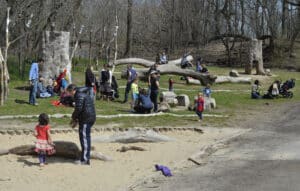
The Zucker Natural Play Area utilizes trees that came down in Hurricane Sandy.

The Zucker Natural Exploration Area—October 2013

A year after Superstorm Sandy, some of the downed trees found new life in the Donald and Barbara Zucker Natural Exploration Area. Tree trunks and branches were used by Prospect Park Alliance to create a new play area for children, where natural materials took center stage and imaginations ran wild. The Exploration Area was an instant hit and continues to be a beloved destination for families in the park.

New York State Grant—2016

The Alliance received $1.2 million in funding from the National Parks Service through the Hurricane Sandy Disaster Relief Assistance Grant Program for Historic Properties, administered by New York State Office of Parks, Recreation and Historic Preservation, to restore the Vale and Lookout Hill (another damaged area) to a healthy, native woodland habitat. With this funding, Prospect Park Alliance began in earnest the work of deliberate and significant restoration work in these storm-ravaged areas of the park.

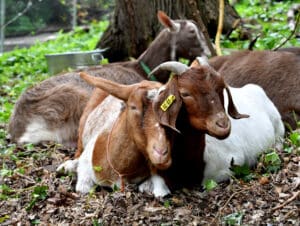
A crew of goats, hired to aid in the restoration work. 

The Goats Arrive—2016 + 2017

In areas of the park where trees fell, invasive plants were able to thrive and overrun the natural ecosystem. Steep slopes and poison ivy made clearing these areas a daunting task for staff, so Prospect Park Alliance called in the experts—a herd of goats! In 2016 and 2017, Prospect Park Alliance brought goats to Prospect Park as part of its woodland restoration efforts in the Vale in the park’s Northeast Corner and Lookout Hill. Instant Brooklyn celebrities, the goats were extremely efficient workers and relished the work of clearing delicious (to them) poison ivy. With full bellies, the goats finished their Prospect Park work season in October 2017, making way for new plantings in the park.

Hurricane Sandy Crew + Landscape Restoration—2016-2020

Prospect Park Alliance brought on a three-person crew to undertake the intensive restoration work necessary in the areas of the park affected by Hurricane Sandy. Tree inventories and health and hazard assessments were completed to quantify and prioritize the removal of damaged trees, including nonnative species that are detrimental to the ecological health of the woodlands. The crew selected a plant palette of climate-resilient and beneficial native plant species to replant in the area. The areas most affected by the storm became hotspots of year-round activity, with the crew and a dedicated team of volunteers hard at work.

In October of 2017, exactly 150 years to the day that Olmsted and Vaux opened Prospect Park’s doors to the public for the first time, Prospect Park Alliance volunteers and staff rolled up their sleeves and got planting in the Vale. Over 20,000 trees, plants and shrubs were planted—a selection aimed at building a healthy and long-lasting forest habitat for birds, wildlife and humans alike. A finishing touch to the lower Vale area was the installation of a rustic woodland trail, which brings accessibility into the heart of the restored area and invites the public to experience the forest as it grows.

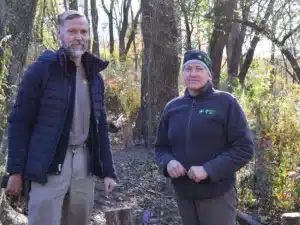
Mary Keehbauch, Deputy Director of Landscape Management, and AJ Logan,  Ecological Zone Gardener, former members of the Hurricane Sandy Crew, standing in the restored Vale landscape.

The work completed was comprehensive and has been a success: this portion of the park has been restored to strong ecological health which will benefit the park’s plant and animal communities long term. The work in this area was undertaken by Alliance staff including the Hurricane Sandy Crew, and was supported along the way by a dedicated team of Prospect Park Alliance volunteers and the members of the Woodlands Youth Crew.

These years of hard work to recover from the damage caused by Superstorm Sandy continue to inform Prospect Park Alliance’s work to sustain the park now, and as we look to the future. The restored areas of the landscape in the Northeast corner of the park are flourishing and providing a blueprint for the work that is planned throughout the Vale area and beyond in the park to make our landscapes resilient as we face the challenges of the climate crisis and work to improve the park for the people, plants and animals that depend on it.

Learn more about Prospect Park Alliance’s work to Sustain the Environment. 

October is Woodlands Month

October 3, 2022

Prospect Park is home to Brooklyn’s last remaining forest—comprising 250 acres of trees, fragile wildlife habitat and paths for the park’s millions of annual visitors to enjoy as the busy city vanishes from view. Prospect Park Alliance has spent decades restoring these woodlands to great success—the ecosystem is healthier than ever and is an essential resource for the people, plants and animals of Brooklyn. The woodlands work continues and you can do your part! Says Alliance Forest Ecologist Howard Goldstein, “Recognize that the forests, the trees, are living, and this habitat is filled with living things. We put in a lot of energy to protect, preserve and restore this green oasis, and the public can do its part. Follow the park rules and the signs. Being respectful of the woodlands really goes a long way.” We’re calling on all park lovers to Be a Park Champion—here’s how:

  • Please keep the woodlands clean! Dispose of litter in designated receptacles or consider taking your litter with you when you leave the park and disposing of it at home.
  • Please stay on paths in our woodland areas, and do not go beyond fencing in our woodlands: this protects fragile nesting areas and helps reduce soil compaction in delicate areas.
  • Please keep dogs leashed at all times in the woodlands: off-leash hours are provided in our large meadow areas, learn more on our Things to Do with Dogs page.
  • Please refrain from building forts in the woodlands: sticks and leaf litter on the forest floor are essential for the creatures that live in the park—leave these for the birds and bees!

Take our pledge today to Be a Park Champion and make a difference in your park! 

On Saturday, October 15, we’re celebrating the first annual City of Forest Day. Presented by Forest for All NYC in partnership with the Parks and Open Space Partners – NYC Coalition and NYC Department of Parks and Recreation, City of Forest Day is a day of 50+ activities across the city to raise awareness of the importance of the New York City urban forest, and the essential role New Yorkers play every day in caring for the “lungs” of our city. Prospect Park Alliance will host three activities to celebrate Brooklyn’s last remaining forest including nature education programming, a volunteer opportunity and a tour of the woodlands in Brooklyn’s Backyard.

See the Prospect Park events and check out the full list of 50+ events happening across New York City!

c. Martin Seck

September is Tree Appreciation Month!

September 9, 2022

September has arrived and Prospect Park Alliance is ringing in Tree Appreciation Month and Climate Week NYC as we remind you to Be a Park Champion and help us extend our Summer of Stewardship into the fall! Prospect Park is home to over 30,000 trees of over 175 varieties—and each plays an essential role in keeping our human and wildlife communities healthy and happy.

While the park’s trees may appear big and strong, like any living thing they are susceptible to injury and disease. With over 10 million visitors in the park each year, the trees in Prospect Park need all of our support:

  • Please do not hang hammocks or decorations from our trees, and avoid climbing or breaking branches: this damages the tree bark and can make trees susceptible to disease.
  • Please stay on designated paths in the woodlands to protect fragile wildlife habitats, and make sure to dispose of your trash properly. This will help our trees grow for generations to come.

Check out the ways in which you can celebrate the park’s trees this month:

7 Surprising Tree Facts: Prospect Park Alliance Forester Mike Marino is an expert on Prospect Park’s trees, and gives an in-depth peek behind the scenes at the amazing facts you never knew about the trees in Brooklyn’s Backyard.

TreeKeeper Database: Did you know? Prospect Park Alliance has an interactive map tool that allows you to look up the species and diameter of every tree in the park, as well as the amazing ecosystem benefits our community receives from the park trees.

Fall Volunteering in the Park: Want to take a hands-on approach to caring for the park and its trees? Prospect Park Alliance has a full slate of fall volunteer opportunities! From our weekend Park Pitch In events to Junior Volunteer Corps, there are many ways to lend a hand in your park—sign up today!

Contribute a Tree to Prospect Park: Prospect Park Alliance runs a Commemorative Tree Program in the park. Community members can donate to plant a new tree in Prospect Park in honor of a loved one or for a special occasion. The gift helps replace lost trees and ensures the ongoing ecological health of the park.

Pledge to be a Park Champion: Right now, more than 1,200 members of our community have taken the Park Champion pledge. Help us reach 1,500 during September! Prospect Park is essential to the health and wellbeing of millions of community members, and the hundreds of species of plants and wildlife that call Brooklyn’s Backyard home. Take this important step to pledge to Be A Park Champion, and enter to win great prizes.

Learn much more about how you can be a Park Champion in Prospect Park.

c.Elizabeth Keegin Colley

7 Surprising Tree Facts

Prospect Park is home to 30,000 trees of over 175 species which provide a variety of essential benefits to our community of plants, people and wildlife. Here at Prospect Park Alliance, we’re asking you to Be a Park Champion by celebrating Tree Appreciation Month!

Prospect Park Alliance’s Landscape Management team plants and maintains trees strategically to help Brooklyn’s last remaining forest thrive and partners with NYC Parks Forestry staff to  to sustain the health of the park and its trees. We chatted with the Alliance’s Forester, Mike Marino, for an inside look into 7 surprising facets of tree life in the park.

1. Slow and Steady Wins the Race

There is generally a correlation between how slow a tree grows and how long it lives. Trees that grow slowly are often the ones that live the longest and remain the strongest. If you spot an Oak tree over 40 inches or so in diameter, it’s likely to have been in the park for over a hundred years, and to have grown very slowly throughout its tenure in the park.

Fun fact: The London Plane trees by the Concert Grove Pavilion and the Lower Concert Grove were all planted at the time of the park’s creation about 150 years ago and are original to the design of the park. Oak and Beech trees are also two of the oldest native species found in Prospect Park, so keep an eye out for these strong and steady species throughout Brooklyn’s Backyard.

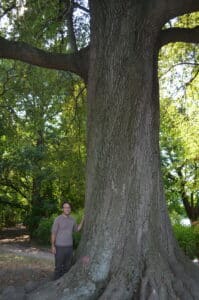
Marino alongside one of his favorite trees in the park: a centuries-old Willow Oak tree at the Peninsula off of Wellhouse Drive.

2. Trees Can Communicate

Through processes unseen by humans, trees can communicate and look out for one another. Trees release hormones through their leaves called volatile organic compounds, and nearby trees can sense and respond to these hormones. This can happen when one tree is infected with an invasive pest or other threat and through its leaves, sends a signal that something is wrong to another tree. The tree receiving this ‘warning’ can then protect itself by emitting a chemical in its bark that makes it less appetizing to a pest. This survival tactic means there is strength in numbers when it comes to trees– and environments like forests can help preserve species and protect trees.

3. Trees Could Not Exist Without Fungi

Visions of toadstools may be front-of-mind when you hear the word ‘fungi’, but small strands of fungi known as mycelium are essential to the health of all trees. These fungi strands perform a variety of important functions, including the decomposition of organic material to recycle nutrients back into the soil. With the help of mycelium, the tree’s roots are able to extend their reach and retrieve the nutrients and water they need to thrive. Through their roots and through fungi, trees can also send nutrients and minerals to other trees, sometimes even trees of different species, to help their fellow trees stay healthy.

A grove of young trees planted as part of Prospect Park Alliance’s Commemorative Tree Program.

4. The Older the Tree, the Greater the Benefits

From cleaning our air, removing toxins, providing wildlife habitats and more, we receive immense environmental benefits from trees. But the benefits of ten young trees do not measure up to the benefits provided by one 100 year old tree. We need mature trees to reap the full span of benefits to our health and environment. Mature trees give shade and cool down the air, they are able to absorb more water which mitigates flooding, and capture greater quantities of carbon dioxide and produce more essential oxygen for us to breathe.

These benefits of fully-grown trees make it all the more essential to be good stewards to both the long-standing trees of Prospect Park and the newly planted ones that will continue to grow, mature and benefit our community for centuries to come.

5. Trees Mist Us

Ever wonder how exactly parks stay so much cooler than city streets in sweltering summer heat? Trees are to thank for the wave of relief we feel from parks in the summer months. Through a process called evapotranspiration, mist gets spritzed out through tree leaves and into the air, keeping the air relatively cool compared to city streets.

Thanks to these trees, on hot summer days, the temperature inside the park can be as much as 10 degrees cooler than the surrounding concrete streets. A single tree can have the same effect as 5 medium air conditioners—with zero electricity used. In Prospect Park, a recent survey of 12,000 of the park’s trees found that our forest produced the equivalent of over $853,874 every year!

6. Forward-Thought is Key

Alliance Landscape Management staff work in collaboration with NYC Parks Forestry staff year round to prune, maintain and care for the park’s landscape and woodland areas to make sure trees in all stages of life are as healthy as possible to benefit our community for generations to come. By considering the way people use the park, the ecology, safety, and health of individual trees, the Alliance and NYC Parks Forestry teams use a multidimensional approach to keep the woodlands and landscape of the park healthy and thriving.

Prospect Park Alliance’s Landscape Management staff work to plant varying tree species that grow well together throughout the park to help strengthen the health and resilience of Brooklyn’s Backyard. If there’s one invasive pest or environmental stressor that attacks a certain type of tree, a diverse range of species makes it so that an entire forest isn’t wiped out in response to something unexpected in the environment. This is a way of having contingencies and back-ups to keep our forest and landscapes healthy.

“Even when we plant new trees, we’re looking 50 years down the road,” says Marino. “This tree will get bigger: How will it play with its neighboring trees and the uses of the park? What pruning will be needed to provide a strong foundation? We need to have forward-thought as we provide proactive work and care.” Marino emphasizes that this is also where stewardship comes in, “All of our daily interactions with the trees, no matter how small, accumulate and impact trees at all stages. Stress builds up in trees, just as it does in humans. And physically, if we damage a tree’s bark, it’s as if our organs were directly beneath our skin, with nothing to protect us from our environment.”

7. Every One Of Us Can Help Prospect Park’s Trees

To help our community reap the benefits of century-old trees and help young trees continue to thrive for future generations, remember to admire trees from afar and not to pick any leaves, flowers or bark that our ecosystem of people, plants, and animals need to stay healthy. Remember not to hang decorations or hammocks on trees to help keep the trees of Brooklyn’s Backyard green and thriving.

Marino also recommends getting involved and learning as much as possible about trees to help support our ecosystem. Resources to learn about the trees of Prospect Park and beyond range from participating in volunteer opportunities, visiting the TreeKeeper Database to explore the specific environmental benefits of each tree in Prospect Park, reading up on tree behavior in books (Marino recommends Peter Wohllleben’s The Hidden Life of Trees), or even taking classes and becoming a licensed street tree pruner with the Trees New York Citizen Pruner Course.

Learn more about how to Be a Park Champion and care for the trees, wildlife, and natural landscape of Prospect Park.

c. Vinata Ciputra

August is Wildlife Month

August 3, 2022

Prospect Park Alliance’s Summer of Stewardship continues, and this August is Wildlife Month! Living in a city, it can be easy to forget that we live alongside all manner of flying, crawling and scampering creatures—and not all of them thrive in our concrete jungle. Prospect Park’s 585 acres are a critical habitat for countless wildlife species who call the park home. This month, get to know these wonderful species and learn how you can #BeAParkChampion and help them thrive.

Test your park wildlife knowledge: Did you know that you can find 15 species of mammals in Prospect Park? Or that Prospect Park Lake hosts a large population of largemouth bass? Take our Prospect Park Wildlife Quiz and see how much you know about the creatures that live in Brooklyn’s Backyard.

Name our Park Champion mascot: We received over 500 submissions from the community for the name of our new mascot—thank you! This chipmunk will help educate our community about how to be a #ParkChampion and important ways to keep the park green and vibrant. Prospect Park Alliance naturalists narrowed down the list to 5 names—vote now on your favorite!

Pledge to be a Park Champion: Right now, more than 850 members of our community have taken the Park Champion pledge. Help us reach 1,000 today! Prospect Park is essential to the health and wellbeing of millions of community members, and the hundreds of species of plants and wildlife that call Brooklyn’s Backyard home. Take this important step to pledge to Be A Park Champion, and enter to win great prizes.

Learn much more about being a Park Champion in Prospect Park.

6 Ways to Take Care of Prospect Park’s Lake

July 11, 2022

July is Lake Appreciation Month, and Brooklyn’s only Lake needs our help to stay healthy and vibrant. Prospect Park’s 60-acre Lake is home to a wide range of fish, amphibians, birds, and home to a variety of beloved park activities. We’re sharing 6 ways that you can help care for the Prospect Park Lake with each visit to the park.

  • 1. Admire the Wildlife from Afar: We all love to watch the turtles and ducks that live in Prospect Park’s Lake, but please admire them from a respectful distance and do not feed them. The animals of Prospect Park have systems in place to find food naturally, which keeps them healthy and safe. When we feed park wildlife, it can attract animals to places they wouldn’t naturally go and can harm these beloved park dwellers’ health.


  • 2. Fish Responsibly: Please protect wildlife habitats for everyone’s enjoyment by following fishing rules. Remember that all fishing is catch-and-release and is allowed in designated areas only, and adults need a license from the NYS DEC. When not disposed of properly, fishing line can entangle birds and other wildlife and result in injury or death. Remember to discard fishing line fragments and hooks in marked fishing line bins or trash cans to keep park wildlife safe.


  • 3. Carry-In and Carry-Out Your Trash: Carry your trash, and anything else you bring into the park, out of the park with you! Dispose of your litter at home where you can recycle and compost it. Ensuring that no trash, debris, or other items are left behind helps keep our Lake healthy and our wildlife safe.


  • 4. Keep Dogs Leashed: Four-legged friends are great park companions. Make sure their visit to the park is positive for the park wildlife and natural areas by following dog-walking rules and safety tips. Remember that off-leash hours are from 6 am–9 am and 9 pm–1 am at the Long Meadow (except ballfields), Nethermead and Peninsula Meadow (except woodlands). At Dog Beach, dogs must be leashed at all times except during off-leash hours.


  • 5. Enjoy the Lake from a Rental Boat: Keep in mind that swimming and private boats are never allowed in Prospect Park’s Lake. Approved boats are available to rent at the LeFrak Center at Lakeside. Following these rules helps keep park-goers as well as the animals and plants of the Lake safe.


  • 6. Stay Safe: Please remember that while the Lake is a cherished part of Brooklyn nature, it is not intended for swimming. Please take caution when near any waterbody and only swim at city pools and beaches where and when lifeguards are on duty.

Be a Park Champion! The health of Prospect Park as a whole impacts the quality of our Lake and the wildlife who call it home. Learn about the many ways that you can #BeAParkChampion and commit to do your part to keep Brooklyn’s Backyard vibrant and healthy.

Visit our Park Champion page to learn more about our stewardship activities, and take the Park Pledge! 

July is Lake Appreciation Month

July 6, 2022

Did you know? Prospect Park is home to Brooklyn’s only Lake, a 60-acre haven for numerous species of fish, birds, turtles, frogs and plants. The Lake also attracts plenty of human admirers, and this July, we hope you’ll join us in being a Park Champion as we celebrate Lake Appreciation Month.

Volunteer at the Lake
All July, Prospect Park Alliance has opportunities for you to lend a hand during Park Pitch In days! Join us for clean up projects on select Saturdays and Sundays—volunteers will be given grabbers, nets, and bags to help fish out trash from along the shoreline of our Lake. Appropriate for supervised youth ages 4-13, Teens and Adults. Sign up to volunteer.

Fish Responsibly
Fishing is permitted in the Prospect Park Lake, and we ask all who participate to be Park Champions and follow these simple rules:

Learn more on our Fishing page. 

Pledge to be a Park Champion
Prospect Park is essential to the health and wellbeing of millions of community members, and the hundreds of species of plants and wildlife that call Brooklyn’s Backyard home. Today, take an important step and pledge to Be A Park Champion, and enter to win great prizes.

Learn much more about being a Park Champion in Prospect Park.